Issue 130. Not a subscriber? Join here for free.
🛝 Spacruzzi Hot Tub Electric Boat
If you want a hot tub boat with real electric-boat credentials, Spacruzzi is the cleanest case study in the market right now. The company sells the boat as both a private-use product and a rental-fleet asset, with a pitch built around electric propulsion, low wake, easy operation, and four-season use. Spacruzzi says each boat is designed, fabricated, and assembled in Montana, meets USCG requirements, and has approvals to operate in some regulated U.S. waters.
The boat itself is closer to a floating spa than a classic runabout, but the spec sheet is real. Spacruzzi lists the current model at 15.6 feet long, 8.2 feet wide, and 2.75 feet of draft. Dry weight is 1,200 pounds. Loaded weight, with 400 gallons of water and six passengers, is about 4,500 pounds. Propulsion comes from a 3.0 Torqeedo internal pod rated at about 3 to 5 horsepower, which puts top speed in the 4 to 5 mph range. One battery delivers about 4 to 5 hours of run time, and the system can scale to four batteries for as much as 16 hours before recharge. Maximum water temperature is 104°F. One point matters for accuracy: this is an electric-drive hot tub boat, but not a pure battery-electric heating system, because tub heat comes from a USCG-compliant propane heater.
What makes the manufacturer interesting is not speed or range. It is product framing. Spacruzzi built a vessel that sits between electric boating, hospitality, and marina rentals. Its rental-operations pitch makes that clear. The company markets the boat to resorts, rental operators, and entrepreneurs who want a higher-yield experience product instead of a standard small-boat rental. That is a smart angle for marine electrification because low-speed guest experiences reward quiet propulsion, low maintenance, and simple controls more than raw performance.

Manufacturer: Spacruzzi
⚙️ $50M Series C VC Raise
Arc Boat Company has closed a $50 million Series C led by Eclipse, with participation from a16z, Menlo Ventures, Lowercarbon Capital, Necessary Ventures, and Offline Ventures. Arc says the money will speed production of electric powertrains for tugboats, ferries, and defense vessels, extending the company’s reach beyond the consumer market it built with the Arc One and Arc Sport.
The round adds to a $70 million Series B in September 2023 and a $30 million Series A in 2021. Prior financing brought in Andreessen Horowitz, Lowercarbon Capital, Abstract Ventures, Dreamers VC, Thirty Five Ventures, and Combs Enterprises. Bloomberg reported that the new round brings Arc’s total funding to $160 million.
The planned use of proceeds matters. Arc tied the raise to production of electric tugboats and to expansion into ferry and defense vessel markets. The company linked the funding to its work with Curtin Maritime, including a $160 million contract to deliver eight hybrid-electric tugboats that will begin service at the Port of Los Angeles. TechCrunch reported that Arc plans to sell propulsion systems to defense contractors while keeping its sport-boat line as proof that its technology can meet performance and durability demands.
For the electric marine sector, this round signals a change in where serious capital may flow next. Arc’s early story centred on premium recreation, brand, and product proof. This raise puts commercial vessels, port equipment, and defense applications at the centre of the pitch. These segments offer fleet economics, repeat orders, and operating profiles that can reward better uptime, lower fuel burn, fewer maintenance points, and tighter emissions compliance. Venture firms are backing a company that owns battery, motor, software, and vessel integration, which suggests investors see value in full-stack marine electrification rather than single-component bets. If Arc executes, the sector gets a stronger case that electric boats are not limited to niche leisure craft. They can become part of core marine infrastructure.
Arc press release - link.
⚓️ University of Michigan Electric Boat
The University of Michigan Electric Boat team has released a full-length documentary on TiDE, the club’s record-chasing electric race boat, and it is one of the best pieces of media the student electric marine world has put out in years. The film follows the team through the build, the setbacks, the testing, and the run to the 2025 Lake of the Ozarks Shootout. It puts real faces on a project that can sound abstract on paper: a student club trying to build one of the fastest electric boats on the water. That kind of storytelling gives the sector something it needs: proof that the next wave of electric marine talent is not waiting for a job posting. It is already in the shop, on the trailer, and at the test site.
UMEB is not a niche hobby club. It is a student-led team with members from more than 15 majors, backed by faculty advisors and split across mechanical, electrical, operations, and business groups. The structure looks less like a campus club and more like a small marine startup. That is part of the appeal. Students are not just learning one slice of the stack. They are working across hull design, battery design, power electronics, controls, testing, logistics, sponsor relations, and media. The club’s own materials show a path from early projects such as Proteus and Snowfinkle to TiDE, then on to a new D-Stock hydroplane and a next F1 tunnel-hull concept.
TiDE is the project that pushed the team into a new class. UMEB describes it as a 22-foot deep-tunnel race boat with a full control system and custom battery packs rated at 69 kWh and 814 volts peak, paired with a 430 kW axial-flux motor and an overdrive Arneson setup. Coverage tied to the 2025 Shootout described the race package as a 22-footer with a Skater canopy, an 800-volt, 67-kWh lithium pack, an Arneson ASD 7 surface drive, and double-stack electric motors rated at 1,150 hp, which points to a build that kept evolving as the team pushed toward race trim. UMEB says TiDE won the electric class at the 2025 Lake of the Ozarks Shootout, the first college team to compete and win in the event’s history, then used the lessons from that program to shape its next boats.
TiDE is a talent engine and a test bed at the same time. The boat forced students to work on custom battery packs, high-voltage integration, race-boat packaging, software and controls, drive-system matching, and safety under real load. Those are not classroom exercises. They are the same problems that will shape fast electric recreation boats, military and patrol craft, workboats, and the supplier base around them. The club also shows how new marine technology gets built: not by one company in isolation, but through ties among students, faculty, sponsors, boatbuilders, motor firms, software tools, and race venues. The electric marine sector gets two wins at once: more engineers who know what a boat demands, and more projects that test ideas before those ideas hit the market.
53,000 views so far!
📅 Social Media Post of the Week
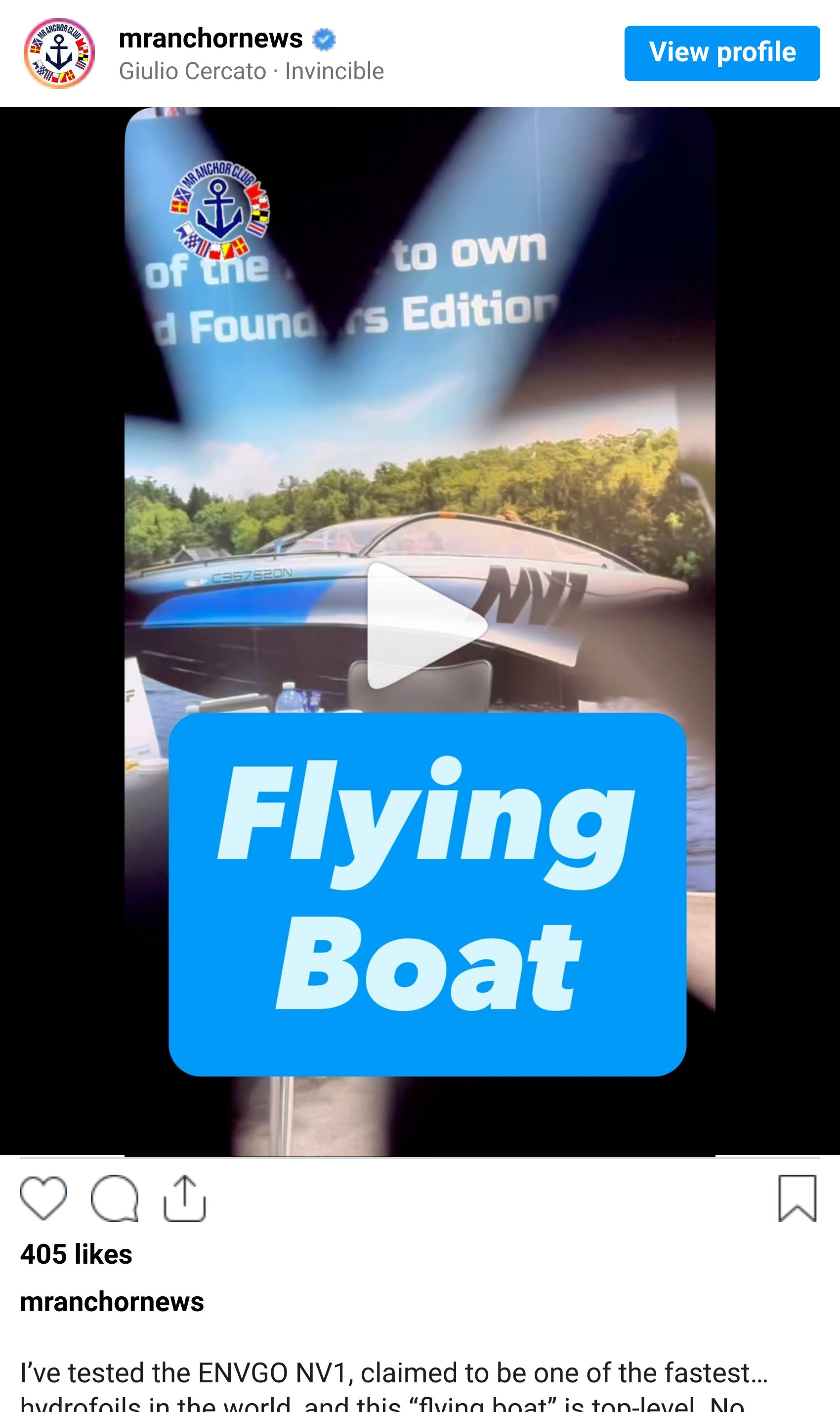
ENVGO NV1!
If you are finding this newsletter interesting or valuable, please help us by sharing this on social media and/or forwarding the registration link to a friend or colleague.
