Issue 123. Not a subscriber? Join here for free.
New! Please check out the eBoat Directory (here). Electric boat models, engines, pwc, e-foil, racing, and more (aiming to be the Sears ‘holiday wish book’ for eboats). On the top right of the landing page is a link to suggest listings - so, please suggest listings! Any feedback to improve this directory is welcomed.
🌊 E1 World Championship Season 3 Kickoff
The 2026 UIM E1 World Championship launched its season with a tight, energetic opener on the Red Sea in Jeddahon January 23–24, marking the start of what looks like the series’ most competitive year so far. Ten teams lined up for Season 3, several with new pilots, refined setups, and upgraded RaceBird foiling packages. The format returned with head-to-head battles feeding into semifinals and a multi-boat Final that rewarded consistency more than raw pace.
Qualifying on Friday produced the first surprise. Team Brady set the early benchmark, putting together a clean lap that put them at the sharp end of the bracket. Aoki Racing Team, carrying momentum from their off-season preparation, slotted into the chase group while Team AlUla and Team Rafa showed gains in stability and cornering speed. Strong crosswinds during the session forced several pilots to back out of laps, hinting at the challenges ahead.
Saturday’s knockout rounds brought the expected chaos. A few teams picked up penalties for buoy contact and long-lap infractions, shaping the semifinal brackets. Aoki advanced by keeping their lines tight and timing the long-lap requirement without losing track position. Team Rafa pushed hard through the mid-field but lost momentum after a minor off-line moment in choppy water. Team Westbrook, quick in practice, struggled with consistency and missed the Final entirely.
The Grand Final delivered a clean six-lap run. Sara Misir opened for Aoki and held firm against early pressure from Team Rafa, protecting her racing line through the technical midfield section. When Dani Clos took over, he managed the closing laps with steady energy use and smooth exits from the buoy turns. Team Brady closed the gap in the final sector but never reached strike range. Team AlUla held third throughout, avoiding mistakes and staying clear of traffic to lock in their first podium of the season.
Aoki Racing Team leaves Jeddah with maximum points and a clear signal they intend to challenge for the championship. Team Brady sits close behind, and AlUla’s podium suggests a deeper fight at the front this year. The series now turns to Lake Como for Round 2, where calmer water and tighter courses may shuffle the order again.
More details: https://www.e1series.com
⚓️ Awake NAVI
Awake is extending its lineup beyond stand-up boards with the NAVI, a seated electric hydrofoiler that the company positions as its own category: a “Foiler.” The pitch is simple: get the hull out of the water, cut drag, and turn the ride into sustained glide rather than sprint-and-splash. NAVI uses a submerged hydrofoil to lift the craft clear of the surface once speed builds, trading the stance and agility of a traditional eFoil for a more stable, seated platform that looks built for distance and approachability.
The design reads like a piece of carbon sports equipment that wandered into PWC territory. NAVI features a lightweight, rigid carbon composite hull developed with the Mannerfelt Design Team, plus a retractable flex mast aimed at transport and shallow-water handling. Awake also calls out “glide wings” tuned for predictable lift and control once the craft is foiling, which matters because the user experience on a seated foiler is less about pumping and carving and more about smooth balance, steady throttle, and managing height above chop.
Controls mirror that intent. Instead of a handheld trigger, NAVI uses a motorcycle-style twist throttle, with a reverse gear, kill switch, and a built-in display running Awake’s own user interface. That cockpit-style layout is a quiet signal about who NAVI is for: riders who want to step into electric foiling without learning a new stance, and owners who want a craft that behaves like a small vehicle rather than a board.
The other key design choice is configurability. NAVI can run with detachable inflatable tube floats, which widen the platform and increase stability. With tubes fitted, Awake cites load capacity up to 250 kg, supporting up to two riders. Remove the tubes and it shifts into a leaner solo configuration, with a stated single-rider capacity around 120 kg. This dual-mode setup feels aimed at resorts and yacht programs as much as private owners: stable, shared rides when you want them, simpler solo runs when you do not.
Range is where NAVI separates itself from most electric rideables on water. Awake quotes riding time up to three hours using two Flex Battery XR4 packs, or around 1.5 hours with two LR4 packs. That “two-battery” architecture is central to the product: NAVI is designed to carry two packs at once, pushing endurance into a bracket that starts to resemble a short cruise rather than a series of short sessions.
Those battery packs matter on their own. Awake’s Flex Battery XR4 product page lists a battery weight of 18.5 kg and frames it as delivering about an hour of ride time per pack, which aligns with the NAVI math when you run two in parallel for the headline endurance figure. Capacity is typically listed around 2.9 kWh for Awake’s XR-class packs by retailers, and NAVI’s compatibility with the broader Awake battery ecosystem is a practical win for existing owners who already have batteries in rotation.
What NAVI does not try to be is a top-speed headline machine. Awake’s own messaging, and most early coverage, leans into efficiency, stability, and ride quality rather than maximum velocity. That makes sense: hydrofoils reward clean lift and steady control, and the seated format shifts the emotional center from stunt session to travel session. In the broader electric-marine arc, NAVI fits the pattern you’ve been tracking: propulsion platforms and use-cases gaining momentum faster than “full electric boats,” with product design moving toward modular energy systems, predictable UX, and longer duty cycles.
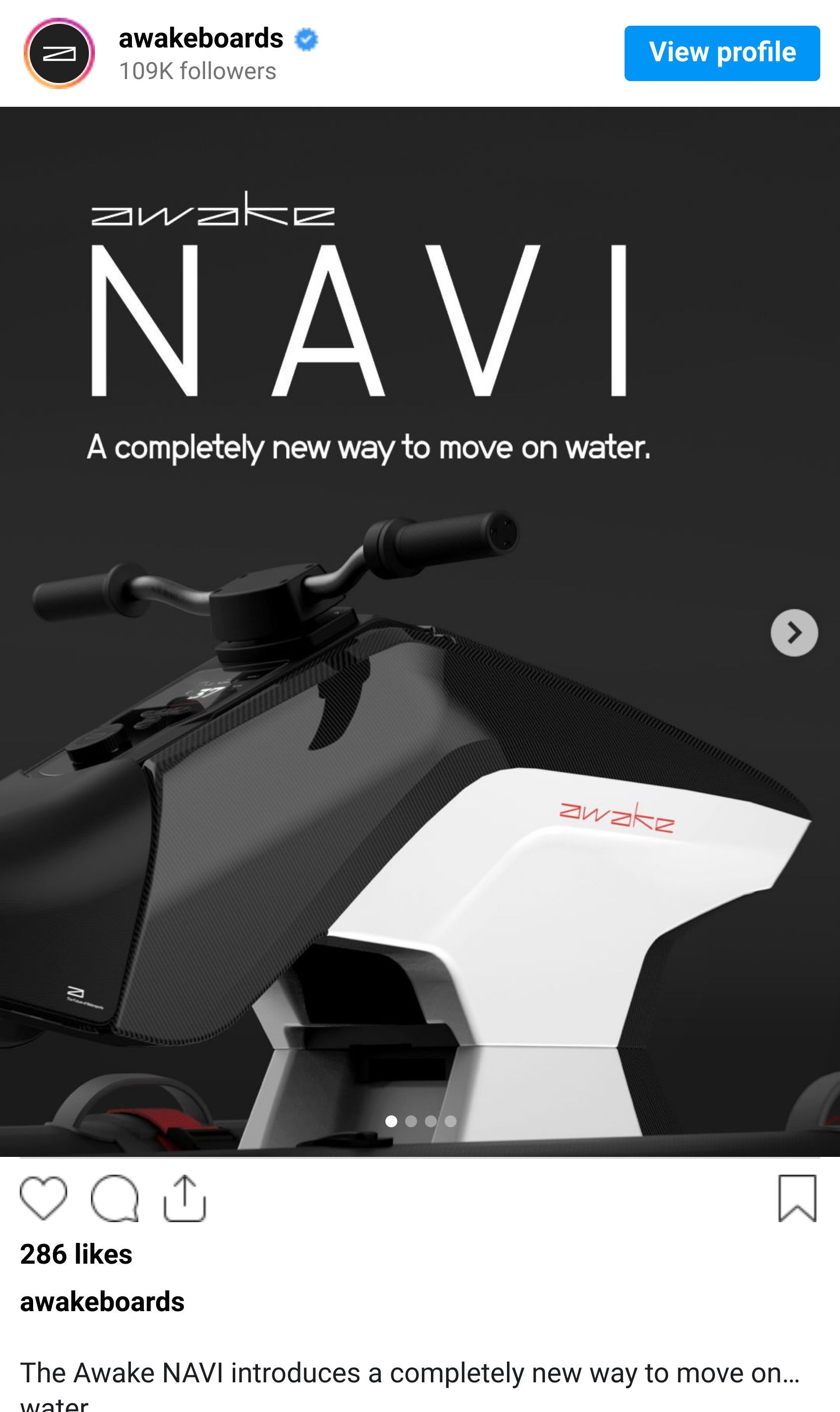
If you want to evaluate NAVI as a “new category,” focus on three questions. First, does the seated format plus tubes expand the rider pool enough to matter, the way beginner wings did for early eFoils. Second, does the battery endurance translate into real utility on the water, or does foiling still keep it in the “session craft” lane. Third, does Awake’s integrated control stack—twist throttle, display, UI—reduce friction for repeat use the way a good marine MFD does on a boat. NAVI’s spec sheet suggests Awake is betting yes on all three.
⚙️ XShore files for bankruptcy
Konrad Bergström’s LinkedIn letter announcing X Shore’s bankruptcy lands with a mix of strife and pride. He writes like a builder who believes in the thing he tried to change: not just propulsion, but the whole boating experience. His core point is simple. Most boats feel like a bundle of parts from different decades. X Shore tried to feel like one coherent product, with electric propulsion as the enabling layer: silence, fewer moving pieces, a different relationship with speed, wake, and presence on the water.
That framing matters for the electric marine sector, because it names the real competition. The benchmark is not “electric versus gas.” The benchmark is whether a day on the water feels easier, cleaner, calmer, and more modern, without asking the owner to become a systems integrator. X Shore pushed hard on that “whole product” idea: industrial design, user interface, interaction design, and a brand that treated boating like a contemporary consumer experience. Even in failure, that work leaves fingerprints. You can see it in how new electric boats present themselves, how they talk about quiet, how they treat software, and how they sell simplicity as a feature rather than an absence.
X Shore’s arc also reads like a case study in what electric marine entrepreneurship asks of a team. The company traces back to Bergström’s long-running idea of an electric boat brand, then formal founding in 2016. Then came the part of the story that hits many clean-tech builders: the moment when engineering ambition meets the balance sheet. In January 29, 2026, X Shore AB filed for bankruptcy.
None of that erases what X Shore proved. First: electric propulsion changes the emotional texture of boating. Silence is not a marketing line; it is a new baseline expectation once you have felt it. Second: design is not decoration in marine electrification. When the powertrain is new, the entire onboard experience is up for redesign, and the winner is the brand that makes the new normal feel obvious. Third: the sector needs more attempts like this, not fewer. If we only celebrate the survivors, we teach future founders to play small. The marine transition will not be led by caution alone. It will be led by repeated shots on goal: hulls, systems, charging, software, service models, and financing structures that fit marine reality.
Bergström ends his message with hope that X Shore might find a new beginning with the right partner, so the original vision can be fulfilled. That is the right note to hold. Bankruptcy is an ending for a legal entity, not for an idea. Assets can be bought. Teams can regroup. Customers can be supported by new operators. Designs can re-enter the market under new ownership. And even if the X Shore name never returns, the category keeps moving in the direction X Shore argued for: boating as a modern, integrated experience powered by electricity.
Entrepreneurship in the electric marine sector deserves to be celebrated even when it does not work out (at least for now).
Read the full post, here.
🖌️ How Electric-Boat Software Turns Battery Data Into Peace of Mind
“Do we have enough to get home?” sits under many on-water decisions. With gas boats, the answer can feel fuzzy. A float sender in a moving tank measures fuel level through slosh, trim angle, and tank shape, then turns that into a gauge reading. Owners learn the habits of their boat and treat the needle as a hint, not a number. Many rigs add fuel-flow sensors and chartplotter logic to improve “fuel remaining,” which is a sign that the default system is not trusted.
Electric propulsion changes the starting point. A battery management system tracks state of charge, voltage, current, temperature, and pack limits. The motor controller knows power draw at each moment. Put those together with GPS speed over ground, and a boat can compute energy per mile and convert stored energy into remaining distance and time. That is the core of range prediction on electric boats: measure energy with high resolution, measure speed, then project forward.
What matters is not the math. It is the product design choices that wrap the math into decisions a boater can use.
Torqeedo states the method in plain terms: its onboard computer links motor consumption data with battery charge level and GPS speed over ground to calculate remaining range on an ongoing basis, visible on the motor display and in its phone app. When paired with TorqTrac, the range becomes a map feature: a live display of how far you can still travel, plus waypoint planning and ETA. This matters because range is not abstract; it is range to that dock or range back to that ramp.
Mercury takes the same idea into a mass-market outboard experience. The Avator line uses integrated GPS for distance-to-empty estimates on its displays. It extends that into the Mercury Marine app, which presents a GPS map with visualized range estimates for trip planning, along with battery state of charge and performance data. This is the software move that reduces stress: not a percent battery icon, but a picture of where you can go from here.
ePropulsion shows the concept in its own control UI. The display includes a distance readout that can show the remaining distance the outboard can travel. It signals a design pattern: electric systems treat remaining distance as a first-class instrument.
Candela takes a broader platform angle: connected boats, sensors, and fleet data, with a connected-vehicle framing that includes real-time data to improve safety and operations. Even when a brand does not market range prediction as the headline, connected telemetry is the path toward better projection because it allows software to learn how boats behave across conditions and update models over time.
So is it plausible to argue that electric boats offer more peace of mind than gas boats on the “will we get home” question? Yes, with limits and honest framing.
Why the electric estimate can be more trustworthy
The fuel source is measurable with high resolution. Battery current and voltage are sensed and computed by design, because the system must protect the pack. That yields a tight view of energy used.
The projection can be anchored to your present draw. If you pull back the throttle, the model updates at once. Marine hulls tend to have predictable consumption curves for a given load.
The UI can show the decision, not the number. Range rings, route overlays, waypoint estimated time of arrival (ETA), and distance-to-empty turn how much into where to.
The weak link is often the tank level signal and what it represents while the boat is in motion. Irregular tank shapes, sender type, installation position, and vessel trim can distort the mapping between level and usable fuel. Many boats rely on a gauge that cannot be fully trusted without calibration tools or fuel-flow integration.
The “putt along and get home” argument. This is plausible with electric propulsion. Reducing throttle drops the hull onto an efficient displacement zone. Power demand falls fast as speed falls, which yields a sharp jump in remaining time and distance. Range software reinforces that behavior because the display converts that throttle change into updated distance-to-empty and time remaining. That feedback loop can steer people away from one last blast decisions.
Gas boats can also limp home at low speed, but the confidence gap sits in the instruments. If the gauge is suspect and the burn rate unknown, slowing down feels like guessing. A calibrated fuel-flow system fixes this, but many boats lack it.
Electric range prediction is not magic. Water current, wind, waves, growth on the hull, payload shifts, battery temperature, pack aging, and prop choice all change consumption. GPS speed over ground can mislead when current is strong. The best systems reduce this risk by updating the estimate from live consumption and pairing range with route context so the operator sees the margin.
The deeper point for the electric-marine story is that software is becoming part of seamanship. It is not only about silent propulsion. It is about instruments that turn energy into decisions, in real time, on a chart, with a margin you can see.
If you are finding this newsletter interesting or valuable, please help us by sharing this on social media and/or forwarding the registration link to a friend or colleague.
