Sponsored by

How 2M+ Professionals Stay Ahead on AI

AI is moving fast and most people are falling behind.
The Rundown AI keeps you ahead of the curve.
It's a free AI newsletter that keeps you up-to-date on the latest AI news, and teaches you how to apply it in just 5 minutes a day.
Plus, complete the quiz after signing up and they’ll recommend the best AI tools, guides, and courses — tailored to your needs.
Not a subscriber? Join here for free.
☀️ QSolarboat: Dutch Solar Racing Team Brings Hydrofoil Speed to the 2026 Season
Out of Doetinchem in the Netherlands, QSolarboat is a solar racing and development project operating inside Qconcepts Design & Engineering — a composites and maritime engineering firm founded by Jurian Rademaker. What started in 2012 as a student project in partnership with the HAN University of Applied Sciences (Hogeschool van Arnhem en Nijmegen) has grown into a hybrid professional-student program that uses competitive solar boat racing as a live test environment for advanced maritime technology.
The team's vessel is a solar-electric hydrofoiling race boat, 5.8 metres in length and 1.60 metres in beam, with a total sailing weight including pilot of approximately 180 kg. Carbon composite construction keeps the structure light, while custom hydrofoils designed and built in-house by Qconcepts lift the hull clear of the water at speed. At the 2026 NK Zonnebootrace in Akkrum, pilot Mitchel pushed the boat to over 50 km/h on foils during the sprint — a result that earned QSolarboat the Sprint Award for the second year in a row, along with a 3rd place overall finish. The team also took 1st place in the sprint at the 2024 NK Zonnebootrace and finished 2nd in the Monaco Energy Boat Challenge Solar Class in 2023, 4th in 2024 with 1st in Slalom, 2nd in Speed Record, and the Spirit Prize.
The boat's onboard systems include a CAN-BUS data network that transmits live telemetry via Bluetooth to a custom app, allowing the team to monitor energy state and manage strategy during endurance events. The solar panels supply roughly the same peak power output as a household coffee machine — making energy management, not raw power, the defining competitive variable. In low-sun conditions, the team's ability to balance foiling thresholds against battery state of charge determines finishing position.
Rademaker describes the boat as a technology testbed as much as a race platform. Lightweight composite structures, hydrofoil geometries, electric drivetrain components, and sensor systems developed for the solar boat feed directly into Qconcepts' commercial work, including small sailing yachts and autonomous aquatic drone programs. Students from HAN University's engineering programs complete internships, semester projects, and graduation assignments through the team, working alongside Qconcepts professionals in a setting the team compares to a Formula 1 operation in terms of race-day strategy and systems pressure.
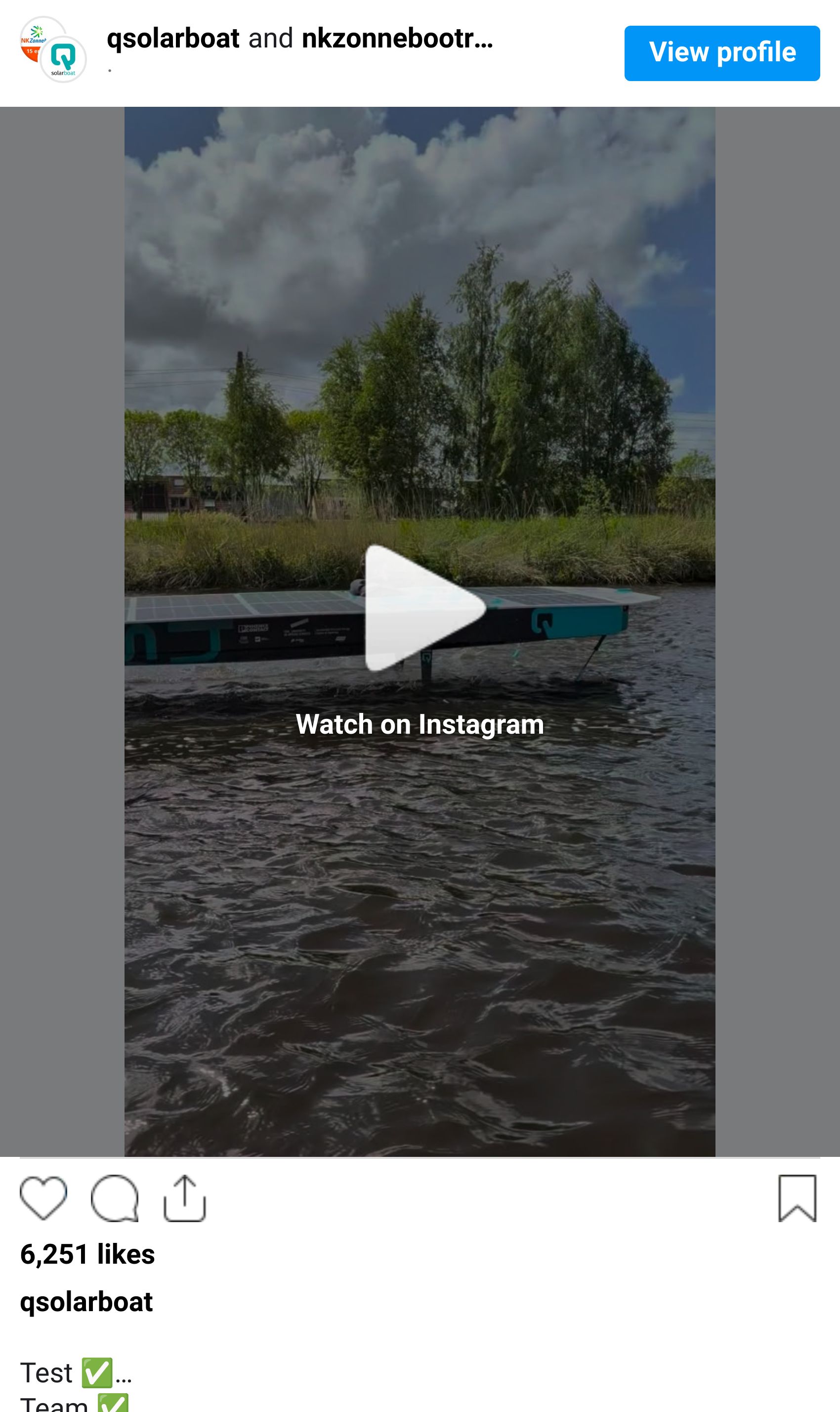
The 2026 race calendar ahead includes Foiling Week on 27 and 28 June, and the Balaton Solar Boat Challenge in Hungary from 28 to 30 August. The Monaco Energy Boat Challenge, the team's marquee annual event at the Yacht Club de Monaco, sits as the season's competitive centrepiece.
Read more, here.
🪵 A 1965 Boesch 510 Gets a Second Life on Electric Power
One of Switzerland's most revered mahogany runabouts has been reborn with zero-emission propulsion. A 1965 Boesch 510 Sport Deluxe, built by the storied Boesch Motorboote AG yard, has undergone a ground-up electric conversion by Oldschool Classics, an Austrian specialist in classic boat and vintage vehicle restoration based near Salzburg.
The Boesch 510 is one of the defining designs of the European wooden runabout tradition. Produced by Boesch from 1965 through 1979, the model sits at 5.10 metres in length and 2.10 metres in beam, with a hard-chine hull, clear-varnished mahogany decking, copper-chromed window frames, and rack-and-pinion wheel steering. Alongside Riva and Chris-Craft, Boesch occupies a distinct position in the collector market — Swiss-built to exacting standards, designed from the outset for water skiing and sport use, and finished to a level of detail that has kept well-maintained examples in active service for six decades.
The conversion strips the original combustion drivetrain and replaces it with a water-cooled electric motor system producing 90 kW peak power and 40 to 50 kW continuous output, supplied through a battery system with components sourced through EV Europe. Cooling is handled via direct water intake — a system well suited to the on-water environment and chosen for its serviceability. The result is a top speed of 50 to 52 km/h and a range of 50 km — figures that comfortably match the boat's original combustion performance envelope while eliminating noise, exhaust, and fuel handling entirely.
Oldschool Classics describes the approach as designing for mature, maintenance-friendly systems. All components are selected for accessibility and long-term reliability, reflecting the realities of classic boat ownership, where the boat may sit between seasons and demands straightforward serviceability rather than exotic engineering.
The workshop's portfolio spans Riva, Chris-Craft, Boesch, Pedrazzini, Swiss-Craft, and other mahogany classics. The Boesch 510 conversion sits alongside a 1958 Riva Ariston electric, a Chris-Craft Capri 19, and a custom 550 Deluxe among its completed electric boat builds — each retaining the original hull and aesthetic while replacing the mechanical core.
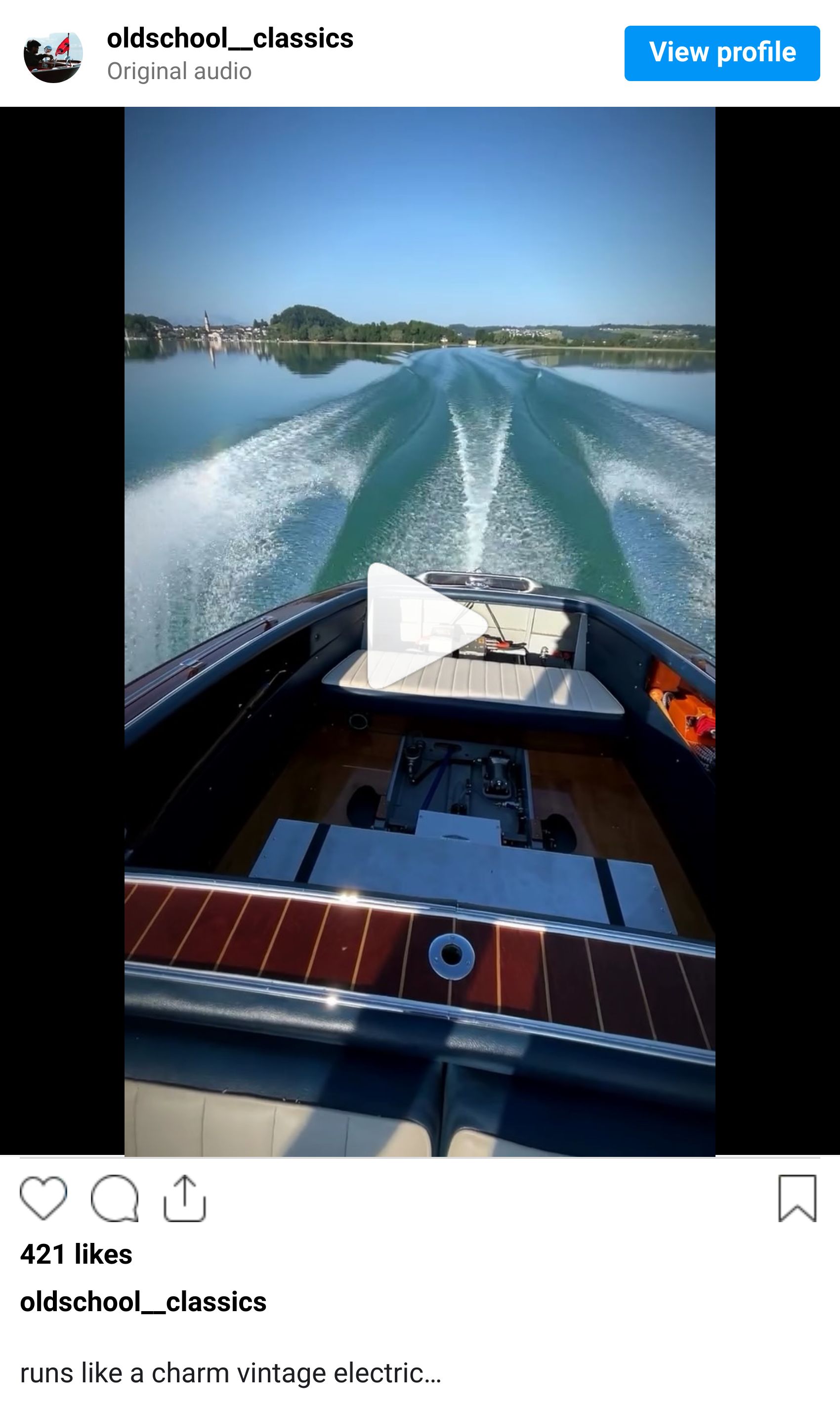
For a boat that has been on the water for sixty years, the conversion represents less a departure than a continuation — the same lines, the same mahogany, the same sport character, now running on electrons rather than petrol.
Read more, here.
⚡ Voltaic Marine's AEW24: The Electric Wake Boat Gets Serious
We covered Voltaic Marine when the Traverse City, Michigan company first turned heads at CES 2025 with the announcement of its AEW24 electric watersports platform and companion AEP26 pontoon boat. At CES 2026 in January, the AEW24 returned — this time as a production-intent platform, no longer a concept, with pre-orders open and deliveries targeted for late 2026.
AEW stands for Aluminum Electric Watersports, and the name carries intent. The hull is aluminium, built from the keel up for electric propulsion rather than adapted from an existing combustion platform. At 24 feet in length with an 8.5-foot beam and 2.5-foot draft, the boat sits within the footprint of a conventional wake boat and remains trailerable at under 10,000 lb loaded. Capacity is rated at 18 people.
The propulsion system is where the AEW24 separates from the field. Peak motor output sits at 570 to 600 horsepower (425 kW) depending on configuration, with torque approaching 1,900 ft-lb (2,700 Nm) — delivered at zero RPM, from a dead stop. A vessel control unit (VCU) acts as the system's brain, monitoring motor output, battery state, thermal conditions, and throttle inputs in real time, balancing performance and efficiency without driver intervention. Integrated bow and stern thrusters tie directly into the electric drive architecture, giving the boat precise low-speed control in tight marina environments.
Battery capacity is substantial at 300 kWh, arranged in a modular architecture that supports scalability and redundancy. Active thermal management handles the sustained high-draw cycles that watersports impose — repeated acceleration, extended towing at consistent speed, and idle time between runs. Voltaic rates runtime at up to 8 hours on a single charge, with fast charging to 80 percent in approximately 3 hours. Top speed is 40 mph, with a 25 mph cruising speed.
The cockpit is built around a Garmin electronics suite, with a joystick controlling both bow and stern thrusters for docking and manoeuvring. All boat systems — lighting, power monitoring, and drive controls — are managed through the helm display stack.

Voltaic CEO Richard Phamdo and COO Cody Covey have been open about the platform's broader ambitions. The AEW24 is the first vessel in what Voltaic describes as a scalable marine platform architecture, with future variants planned for commercial utility and defence applications. The low acoustic and thermal signature of electric propulsion makes the platform a credible candidate for military use cases — an application Voltaic has confirmed is in active development. All future models are intended to share unified hardware and software systems, reducing support complexity and enabling fleet management at scale.
The AEW24 is built in the Midwest and positioned as a serious challenger in the electric wake boat segment — alongside Arc Sport and Nautique's electric program — at a moment when the category is moving from novelty to competition.
Read more, here.
🌊 This Week in Electric Boats: What's Making Headlines
The electric marine industry doesn't slow down. Here are the five stories worth watching this week.
1. The Harmsworth Trophy Goes Electric — and Gets a Benchmark The historic British Harmsworth Trophy has relaunched as a fully electric timed challenge between Poole and Cowes. The SpiritBARTech F35 — a collaboration between Spirit Yachts and BAR Technologies — completed the inaugural run on May 27, covering the course in 1 hour, 36 minutes, 53 seconds at 30.35 knots average. The trophy will go to the fastest electric boat to beat that time before November 2026. Link
2. Seawork 2026 Opens in Southampton (June 9–11) The UK's leading commercial marine show is underway this week, with a sustainability and zero-emission technology focus. The University of Southampton is unveiling its Centre for Green Maritime Innovation at the event, with multiple electric and hybrid commercial vessel exhibits on the floor. Link
3. World's First Fully Electric Remote-Controlled Boat Launcher Debuts at Seawork New Zealand firm Tectrax, through UK partner SBS Trailers, is showing the C-ROVR at Seawork — a wireless remote-controlled electric boat launching system with a 500-metre operational range, a decade in development. No tow vehicle required. Link
4. Nautical Ventures Opens New Dania Beach, Florida Location A new electric boat retail and demonstration hub is opening in South Florida, with on-water demos central to the concept. Grand opening is June 17. Link
🌊 Lake Berryessa Electric Boat Festival 2026
Beautiful line-up of eBoats! Many thanks to the organizers for sharing a sneak peek picture from this weekend’s event - we plan to share more details on the happenings at this event next week.

Source - Charged Marine
If you are finding this newsletter interesting or valuable, please help us by sharing this on social media and/or forwarding the registration link to a friend or colleague.
