Issue 128. Not a subscriber? Join here for free.
⚓️ Swiss Solar Boat
Swiss Solar Boat’s next boat is the Renewable Energy Foiler, or REF, a three-seat hydrofoil that pushes the Swiss team past a pure-solar race machine toward a hybrid package built for speed and range. The published spec sheet is strong: 160 km of autonomy, a 60 kW fuel cell, 6 m² of solar panels, a 350-bar Type IV hydrogen tank carrying 8 kg of gaseous green hydrogen, a custom high-voltage battery, retractable foils, 25-knot cruise speed, and 35-knot top speed. In the team’s energy layout, hydrogen is the main energy source and the solar array supports battery charging.
What gives the boat weight is the group behind it. Swiss Solar Boat is a student-led EPFL project with more than 80 students from different sections of the school working on zero-emission foiling craft. The first boat, Dahu, gave the team a strong record: EPFL says it was the world’s first foiling proa, took podium finishes at the Monaco Energy Boat Challenge, won the eco-conception award in 2021, won the championship race in 2022, and made a zero-emission Lausanne–Évian crossing in 2024 after a hydrogen retrofit. That background makes the REF look like a serious marine R&D program, not a class project, with competition proof behind it.

Source - Swiss Solar Boat website
The REF matters because it tackles one of the hardest problems in electric boating: how to hold speed without giving up range. Swiss Solar Boat targets first launch in spring 2026, first tests on Lake Geneva during the 2025–early 2026 integration phase, and a Monaco Energy Boat Challenge SeaLab debut in summer 2026. Team updates from late 2025 say the hull was decked and prepared for cable and pipe integration, the foils entered production, the motor was assembled and tested, and the fuel-cell, battery, and low-voltage systems went through bench validation. If the REF hits its numbers on the water, it will stand as a strong sign that solar support, hydrogen energy, and foils can share the same hull in a boat built for more than a demo lap.
Explore further details here: Swiss Solar Boat
🏄🏾♂️ Hydroflyer FF
Hydroflyer’s latest launch is the Hydroflyer FF, a limited-run push into the high-output end of the eFoil market. The company is framing the FF as its fastest and most powerful board yet, with a 10,000-watt motor and a claimed speed of more than 60 km/h.
The FF comes in two versions, Cruiser FF and Sport FF, both priced at $18,995. Both packages include the board with deck grip, handlebar assembly, a new low-profile throttle, a powered carbon fibre keel assembly with high-output motor, front wing, fuselage, stabiliser wing, a high-output lithium-ion battery, premium high-speed charger, accessories case, toolkit, and an online manual. Hydroflyer’s site shows a summer 2026 timeline, with July 2026 shipping on the FF launch page and August 2026 delivery on the two product pages.
On paper, the two FF models split into stability and aggression. The Cruiser FF uses the larger platform at 226 cm by 86 cm with 160 litres of volume and a 1,225 sq cm mid-aspect foil. Hydroflyer calls it extreme performance on the stable Cruiser platform and says the board pairs its V-nose entry with the 10,000W motor for explosive acceleration; the Cruiser FF page also cites 65 km/h top speed in the description, while the spec list says 60 km/h. The Sport FF trims the package to 152 cm by 83 cm, 129 litres of volume, and a 1,097 sq cm mid-aspect foil. Hydroflyer says it is 33% shorter than the Cruiser for faster directional change. Both use a 78 cm carbon keel, full carbon fibre construction, customizable colour options, a smart low-profile throttle, and Version 2 Hydroflyer O/S.
What makes the FF launch stand out is not just the raw number. It is the way Hydroflyer is pushing its handlebar-led format deeper into performance water sports. Across the broader Hydroflyer platform, the brand leans on detachable handlebars, waterproof mounted or handheld control, five speed levels, LCD rider feedback, modular wings, a V-shaped nose, and a build aimed at stability, control, and progression. The FF keeps that layout and adds a major jump in output, which puts it closer to a foil-borne personal watercraft than a surf-style eFoil.
The jump matters because Hydroflyer’s standard published tech figures for the wider range sit at max 5,500W, 45 km/h top speed, 42Ah/52V battery data, and 90 to 120 minutes of ride time. The FF product pages move the headline to 10,000W and 2.5 hours of runtime, but Hydroflyer has not posted the same battery voltage or capacity detail on the FF pages. That leaves the launch with a clear message on speed and power, but with some open questions on the engineering breakdown behind those gains. For eBoat readers, the Hydroflyer FF looks like a bet that the next premium electric watercraft buyer wants thrust, stance, and a harder edge, not just glide.
Check out the product in further detail here: Hydroflyer FF
⚙️ Pascal Technologies - Riding on Air
Pascal Technologies’ latest build update points to one of the more interesting commercial electric boat projects in Europe. In the LinkedIn post, the company showed welded aluminum frames and AirHull hardware at Alumax Boats in Meppel and said launch is planned for later this year. The boat is being built for Rotterdam Watertaxi, which Pascal describes as the largest passenger waterway operator in the city. Pascal says the vessel will pair its AirHull hull system with a full electric powertrain and energy management system for high-use service on Rotterdam’s rivers and harbours, with construction at Alumax and project status listed as under construction in 2026.
At the core is Pascal’s AirHull system, which uses a hull cavity, a bow lift fan, and an aft flap to create and hold an air cushion under the boat. Pascal says the setup cuts total power use at planing speeds by 30 to 50 percent against planing monohulls, with the fan accounting for 5 to 15 percent of total energy use. The company says AirHull can double electric range at high speed, is designed for high-performance vessels in the 8 to 40 meter range, can be built in aluminum, and can work with electric, hydrogen, or fuel-based setups plus pods, stern drives, outboards, shafts, and waterjets.
Pascal has published the system scope for the Rotterdam build, but not the headline buyer specs that many eBoat readers will want. There is no posted battery size, motor output, passenger count, target speed, range, or charge time for this boat in the project material that is public today. What Pascal has put on the record is the stack: AirHull, electric propulsion, battery integration, power distribution, consumer management, vessel controls, operator interface, energy management, and commissioning. That points to a company that is selling more than a lift hull. It is selling a full vessel system for operators that need uptime, one interface, and one integration partner across core systems.
The builder choice matters. Alumax positions itself around aluminum workboats and water taxis and already markets electric passenger craft such as the 14.3 meter Waterbus Fifty, with room for 51 passengers. On the operator side, Rotterdam’s water-taxi network is pushing toward zero-emission service by 2030. Pascal is working with Rotterdam Watertaxi on a second project as well: a 12 meter, 24-passenger electric catamaran that uses Pascal’s standalone powertrain and energy management system without AirHull. Taken together, the Meppel build looks like a real test of whether hull efficiency plus full-system electric integration can move urban water transport into faster, harder-duty service.
Read more here: Pascal Technologies
⚙️ Demo & Events
Voltaic Marine is demoing its AEW24 electric wakesurf boat in Austin, TX this week —a 24-foot aluminum model with ballast tanks, a wake system, up to 570 hp, a 300 kWh battery, a 40 mph top speed, room for 18 people, and up to 8 hours of runtime—and you can request a demo here.
Advanced Maritime Technology Expo 2026
Dates: June 16-18, 2026
Location: RAI Amsterdam, Amsterdam, Netherlands
Details: Link
Nice Boating Tomorrow 2026
Dates: March 19-22, 2026
Location: Port of Nice, Nice, France
Details: Link
Palm Beach International Boat Show 2026
Dates: March 25-29, 2026
Location: West Palm Beach, FL
Details: Link
If you have or know of an upcoming electric boat related event, please suggest a listing using this link.
📅 Social Media Post of the Week
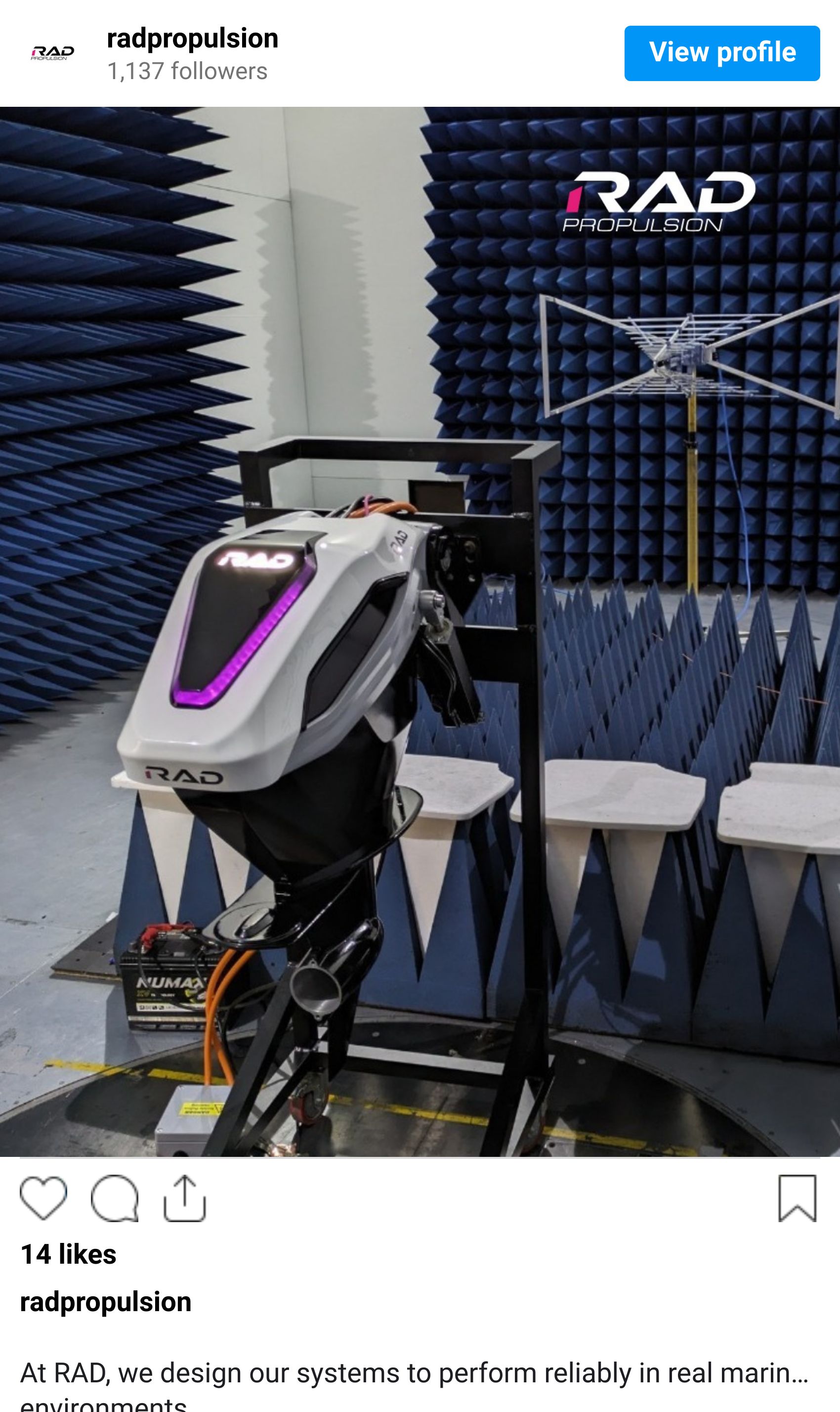
Rad Propulsion doing some EMC testing.
You think 4x faster than you type. Why slow down?

Wispr Flow turns your voice into ready-to-send text inside any app. Speak naturally and Flow handles the cleanup -- stripping filler words, fixing grammar, formatting everything properly.
For developers, this means:
Dictate into Cursor, VS Code, or any IDE with full syntax accuracy
Give coding agents 10x more context by talking instead of typing
Write PRs, docs, and Linear tickets without switching to a text editor
Respond to Slack and email without breaking your flow state
Used by teams at OpenAI, Vercel, and Clay. 89% of messages sent with zero edits. Millions of users worldwide.
Available on Mac, Windows, iPhone, and now Android - free and unlimited on Android during launch.
If you are finding this newsletter interesting or valuable, please help us by sharing this on social media and/or forwarding the registration link to a friend or colleague.
