Issue 124. Not a subscriber? Join here for free.
See the outboard kit giveaway contest in the Bixby article below! (not sponsored)
⚓️ FluxJet Kayaks
FluxJet Kayaks sits in a narrow but growing corner of electric propulsion: integrated jet drives inside fishing-kayak hulls. The idea is to keep the deck clear, protect the propulsion system from weeds and structure, and let anglers move through shallow water without exposed props. The hull is a rotomolded HDPE platform measuring 132 inches long and 35 inches wide with a listed height of 12 inches. Capacity is 400 pounds, which includes paddler, gear, and battery. Weight scales with configuration. The bare hull is listed at 88 pounds, the fitted hull at 112 pounds, and the rigged hull at 122 pounds. Once a battery is added, real carry weight can approach 170 to 200 pounds depending on pack size and chemistry.
At the center is a compact jet system in the 1,000-watt class. FluxJet states a top speed greater than six miles per hour under favorable conditions. The jet nozzle handles steering instead of a rudder or stern-mounted propeller. This approach trades some low-speed efficiency for clean lines, safety near weeds, and consistent behavior in skinny water. Since thrust governs steering authority, handling changes once throttle input drops to zero. Anglers will use short bursts of power and occasional paddle strokes to pivot and correct at low speed.
The battery interface defines most performance outcomes. Instead of shipping the kayak with a proprietary pack, FluxJet accepts 12, 24, 36, 48, and 60-volt batteries through a Group 31 battery box with internal dimensions of 14 inches long, 6.8 inches wide, and 9.8 inches high. This wide voltage range implies a controller tuned for broad input tolerance. Higher voltage reduces current for the same power output and improves peak thrust headroom. Lower voltage supports long endurance with high amp-hour marine batteries many anglers already own. FluxJet uses a 12-volt 165-amp-hour reference battery (2,112 watt-hours) for its published runtime example of up to 14 hours. That figure maps to mixed-throttle, fishing-style operation. At sustained high power, the same pack delivers about two hours.
Real range depends on watt-hours. A 2.1-kilowatt-hour battery works for short transits and extended low-throttle positioning. Larger packs extend session length in a linear way. Battery chemistry, discharge limits, wiring loss, and temperature performance shape the true duty cycle. The choice to leave batteries out of the purchase pushes owners to think of the kayak as a platform with multiple possible energy setups.
Fishing integration includes a transducer-ready section under a cover plate, a front hatch, a rear tankwell for crates and gear, and adjustable foot pegs. The beam offers enough stability for stand-and-fish applications, and the weight distribution supports common rigging layouts. All rigging sits clear of the jet intake and nozzle.

Source - Fluxjet Kayaks website
Early 2026 production runs sold out. Later 2026 allocation remains available. If the company maintains consistency in hull molding and jet assembly, this format presents a clean approach for anglers who want electric thrust without the compromise of exposed props.
🏄🏾♂️ Upcoming Event
Miami International Boat Show 2026 (Feb 11-15, 2026) – The largest boat show in the Americas with a major focus on electric innovation. View Details
For this and other events, check out the Events listings on the eBoat Directory, here.
🏄🏾♂️ Bixpy electric propulsion systems
Bixpy builds compact electric propulsion systems for small craft that need portable thrust, simple installation, and sealed electronics. The line covers two core motors and two outboard batteries, supported by a wide set of mounts that let one system move between kayaks, SUPs, inflatables, and tenders. The design centers on a small brushless motor pod with a shrouded prop, a waterproof battery that serves as the control interface, and a wireless remote for speed control and safety.
The K-1 Motor is the compact pod-style option. It produces 33 lb of thrust when paired with the PP-378 battery and 38 lb of thrust when paired with the PP-768 battery. Dimensions are 9.05 in long, 3.6 in wide, and 6.32 in high, with a shroud width of 3.15 in. Weight including cable and mount adapter is 2.8 lb. The cable length is 55 in. The unit is depth-rated to 100 ft. The motor is positioned as a 450 W class system with enough output for sustained assist on paddlecraft and light-duty propulsion for small inflatables.
The J-2 Motor fills the outboard-style role for users who want a transom or fin-mount installation. Published output is 450 W with 32–33 lb of thrust depending on load and battery choice. Typical reported performance reaches 5 mph on efficient hulls. Motor weight is 930 g. Runtime varies with hull drag, payload, wind, and operating speed, with long duration possible at lower levels of power draw.
The PP-378 Outboard Battery (V4) is the lighter pack in the line. Capacity is 378 Wh at 25.2 V and 15 Ah. Weight is 7.17 lb. Dimensions are 11.3 × 8.7 × 3.2 in. Recharge time is about 5.5 hours on the wall charger. The pack includes 5 V and 12 V accessory outputs. This battery is the choice for users who prioritize portability and handling.
The PP-768 Outboard Battery (V2) doubles capacity to 768 Wh at 25.6 V using a LiFePO4 chemistry. Weight is 21 lb. Dimensions are 15.7 × 7.9 × 4.8 in. Recharge time is about 6 hours. The pack includes a Bluetooth remote and a magnetic kill switch with leash. This option delivers longer sessions, more headroom at higher thrust settings, and the higher output rating on compatible motors.
Taken as a system, Bixpy’s value is flexibility. The motors provide enough thrust for displacement hulls under load without the bulk of traditional trolling motors or the mounting constraints of larger electric outboards. The batteries are sealed, compact, and built for exposure to spray, rain, and submersion events. The mounts cover most paddlecraft and small inflatables, which lets a single motor move across seasonal use cases.

The tradeoff is power envelope. These are not substitutes for multi-kilowatt outboards on larger hulls. They excel as assist motors for paddlecraft, backup propulsion for small tenders, and quiet positioning tools for anglers. Within that mission, the thrust ratings, battery capacities, and modular hardware give owners clear expectations and predictable performance.
Read more, here.
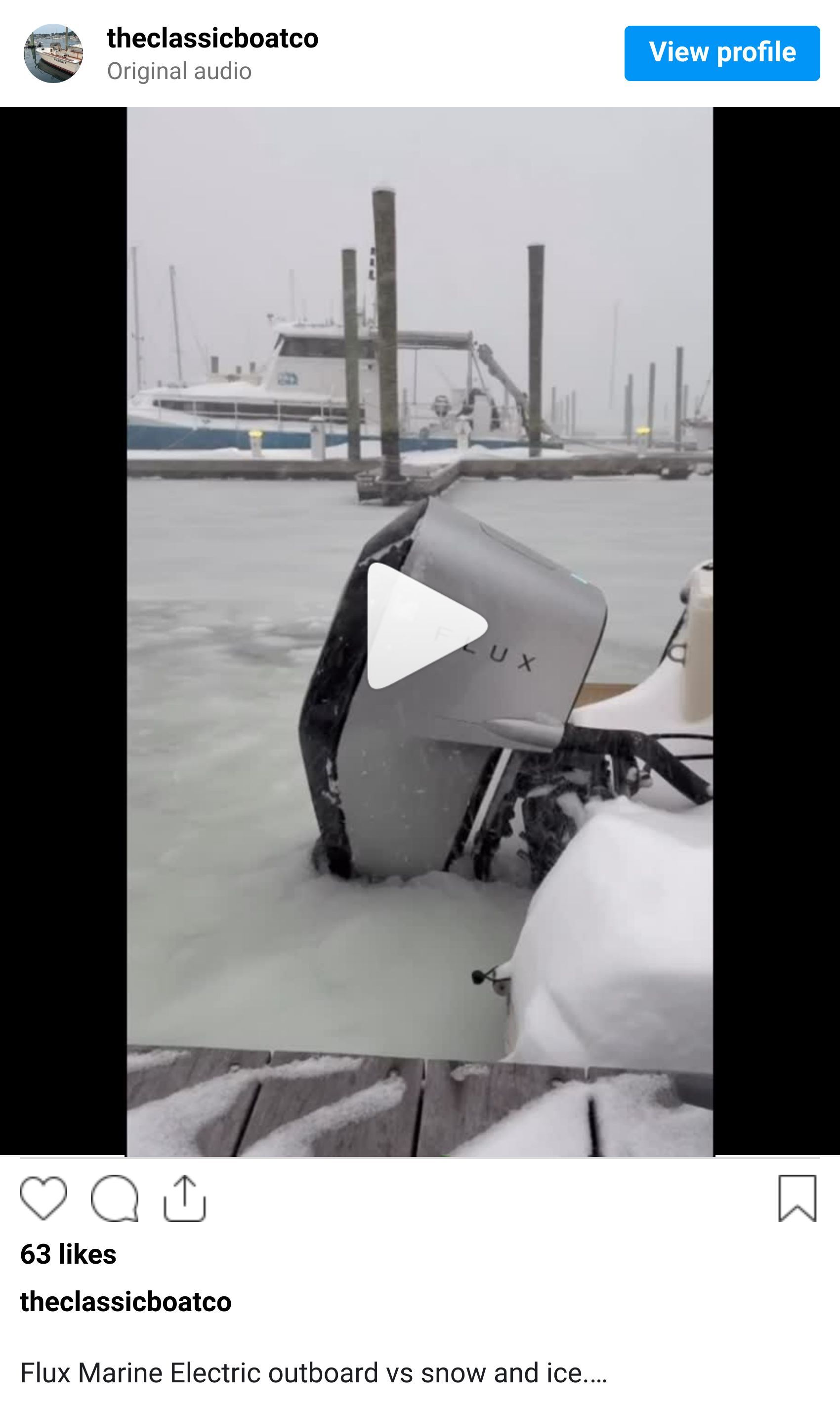
⚙️ Social Media Post of the Week
Extending the boating season (to say the least). Electric outboard for the win.
📄 New listings on the eBoat Directory
1. Silent 62 3-Deck (Yacht)
The ultimate solar-powered ocean explorer. An ocean-going solar-electric catamaran featuring an additional third deck for expanded living space and virtually unlimited solar range. View details, here.
2. Waydoo Flyer EVO (eFoil)
The next generation of modular flight. Features a cable-free integrated design and advanced flight assist stabilization for the most refined eFoiling experience available today. View details, here.
3. Ingenity EL (Watersports)
Pure torque and zero emissions for wake and wave. An all-electric performance wake boat focused on luxury and tow sports, using automotive-grade battery technology. View details, here.
4. Crest Current (Pontoon)
Modern luxury meets clean electric propulsion. A 20-foot pontoon specifically engineered for the Mercury Avator system, featuring luxury upholstery and integrated solar readiness. View details, here.
5. RAND Supreme 27 (Luxury Day Boat)
Scandinavian luxury meets electric performance. A sleek day boat designed for social leisure and high performance, featuring a wave-piercing bow and enough room for 12 people. View details, here.
If you are finding this newsletter interesting or valuable, please help us by sharing this on social media and/or forwarding the registration link to a friend or colleague.
