Issue 122. Not a subscriber? Join here for free.
⚓️ NV1 North American Launch
ENVGO used the Toronto International Boat Show (TIBS) to make a clear statement about where the electric-marine sector is heading. Their official North American launch of the NV1 wasn’t framed as a speculative technology demo but as a confident entry into the market, aimed at showing that high-performance electric foiling is ready for prime time. The NV1 arrived not as a prototype surrounded by caveats, but as a product intended to move electric boating forward in a way the broader industry has been waiting for.
The company’s story is a strong part of that momentum. Founded in 2021 by Mike Peasgood and a team with deep roots in Aeryon Labs—the Ontario drone company later acquired by Forward-Looking Infrared (FLIR)—the group brings real experience in mechatronics, flight control systems, and the discipline required to ship complex hardware. This background gives them credibility when they talk about integrated design. To ENVGO, the NV1 isn’t an electric boat with add-on foils; it’s a complete system where hull, foils, propulsion, sensing, and software are developed together. That holistic approach is exactly what the electric-marine sector needs as it matures beyond early experimental craft.
Investor interest has followed that narrative. ENVGO raised a US$2M seed round led by Two Small Fish Ventures, with participation from Garage Capital. These investors tend to back teams who blend hardware, software, and data into scalable platforms, and their involvement gives ENVGO the runway to push production, expand partnerships, and support builders who may want to adopt the company’s technology. This matters because a strong ecosystem accelerates progress for the entire sector.
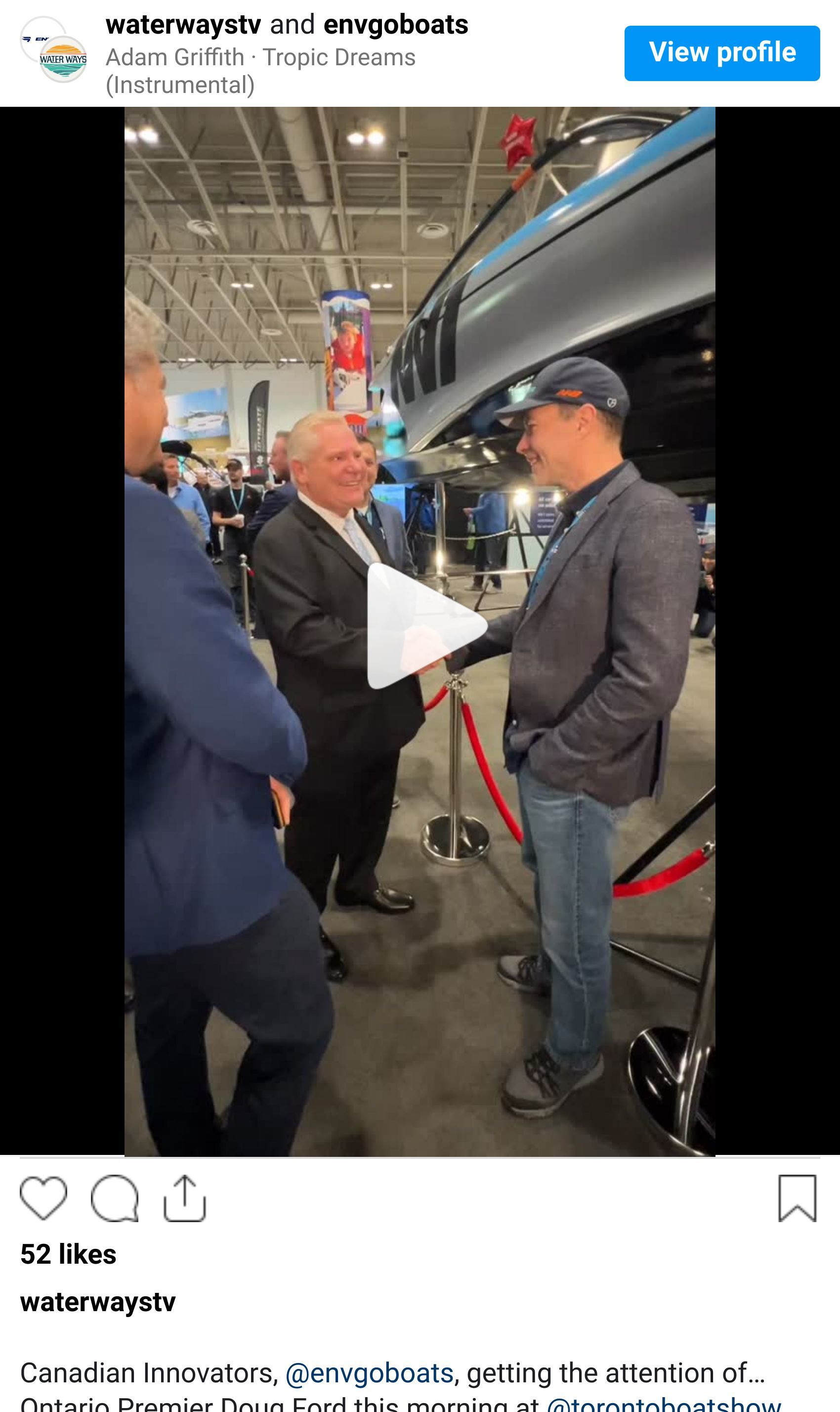
TIBS also offered ENVGO more than a product stage. Their booth hosted Ontario Premier Doug Ford for a photo and conversation about building clean-tech manufacturing in the province. Regardless of politics, the visibility matters. It signals institutional interest in electric marine innovation and reinforces the idea that Ontario can become a hub for advanced boatbuilding and water-transport technology. The electric-marine community benefits every time a government leader pays attention to this space.
Then there’s the NV1 itself. The boat is positioned as a performance-class hydrofoiling electric runabout with numbers that represent a tangible step forward in consumer-ready electrification. Reports consistently land on an 80 kWh battery, peak motor output around 245 kW, continuous power around 125 kW, top speeds near 43 knots, a comfortable cruise around 22 knots, and a reported range of roughly 74 miles under typical use. These figures place the NV1 in territory normally dominated by gas-powered performance boats. Foiling lets ENVGO turn stored energy into speed and reach in a way that aligns with the sector’s goal: achieve meaningful range without giant batteries or heavy compromises.
The integrated foils and approximately 25-foot length point to a boat meant for real-world use on lakes and coastal waters. With foils stowed it is suitable for most marinas, ramps, and lifts in regions like Ontario, BC, the Pacific Northwest, and the Great Lakes. This kind of practicality is essential for widespread adoption of new electric technologies. When a boat fits into existing boating patterns, adoption grows.
ENVGO placed particular emphasis on their control system, described as an AI co-pilot that manages stability, lift, docking assist, collision awareness, and energy planning. For electric boats, intelligent control is as important as raw battery capacity. It helps new owners feel confident, reduces mistakes that shorten range, and keeps operation smooth. A more accessible foiling experience supports the broader sector by making advanced electric boats easier to drive, enjoy, and maintain.
All of this adds up to a moment that lifts the whole category. The electric-marine industry thrives when strong companies push boundaries with products that are innovative but still grounded in the realities of ownership and manufacturing. ENVGO’s NV1 brings attention, investor confidence, engineering credibility, and a clear example of what modern electric boats can achieve when performance, efficiency, and user experience are developed as one system.
For readers of the eBoat Newsletter, ENVGO’s launch is encouraging. It shows that electric boating is maturing into a phase defined by purpose-built platforms, meaningful range, and design that welcomes everyday boaters—not only early adopters. It signals that Ontario, and Canada more broadly, can play a real role in advancing the next generation of marine technology. The NV1 gives the sector a boost of energy and optimism at exactly the moment electric propulsion is moving toward mainstream expectations.
Read more of the details on their North American launch, here.
🏄🏾♂️ Aerofoils’ eFoil
Aerofoils’ flagship eFoil story begins like a lot of German engineering ventures: two specialists see a constraint, decide it shouldn’t exist, and build their own path around it. Co-founders Franz Hofmann and Christian Rößler spun out Aerofoils GmbH in 2017 to move faster, then partnered with Audi’s design group to shape an eFoil with aerospace-style packaging, a sealed drive, and a focus on rider safety. Today the company is still fully active, releasing new inflatable models, appearing at major European shows, and maintaining a live direct-to-consumer storefront.
The technical signature is Aerofoils’ jet-drive approach. Instead of an exposed prop, the system uses an impeller housed inside the foil’s fuselage. The goal is a cleaner hydrodynamic profile and a safer powertrain. Paired with a carbon mast and a rigid drive pod, the platform feels planted at low speeds and efficient once lifted.
A representative configuration for readers is the Adventure Set. The board carries 103 L of volume with dimensions of 176 × 72 × 15 cm and weighs 11 kg. Its footprint supports riders up to roughly 120 kg depending on wing selection and water state. The mast is an 80 cm performance jet-drive unit, which sits deep enough to keep the wing below surface chop without feeling unwieldy during takeoff.
The freeride wing set—1350 front and 400 stabilizer—delivers early lift at modest throttle. This matters because most first-time eFoil wipeouts come from over-throttling to force takeoff rather than letting the foil fly at the speed where the wing is efficient. A larger front wing helps smooth this learning curve.
Battery choice defines the character of the ride. The lighter 1.13 kWh pack offers up to about an hour on the water and keeps overall weight down, which beginners tend to appreciate when carrying the board to the launch point. The 2.23 kWh endurance pack roughly doubles ride time to a claimed 120 minutes and increases range to around 40 km, with the trade-off of more mass. Both battery configurations are sealed, swappable, and designed around fast-charge capability.
Top speed for the Aerofoils line hovers near the 50 km/h class depending on board, wing, rider weight, and conditions. Real-world range, as always, depends on throttle discipline and water state. What stands out is how integrated the system feels. Sensors track acceleration, tilt, temperature, and water intrusion, making the eFoil behave more like a packaged mobility product than a DIY board.
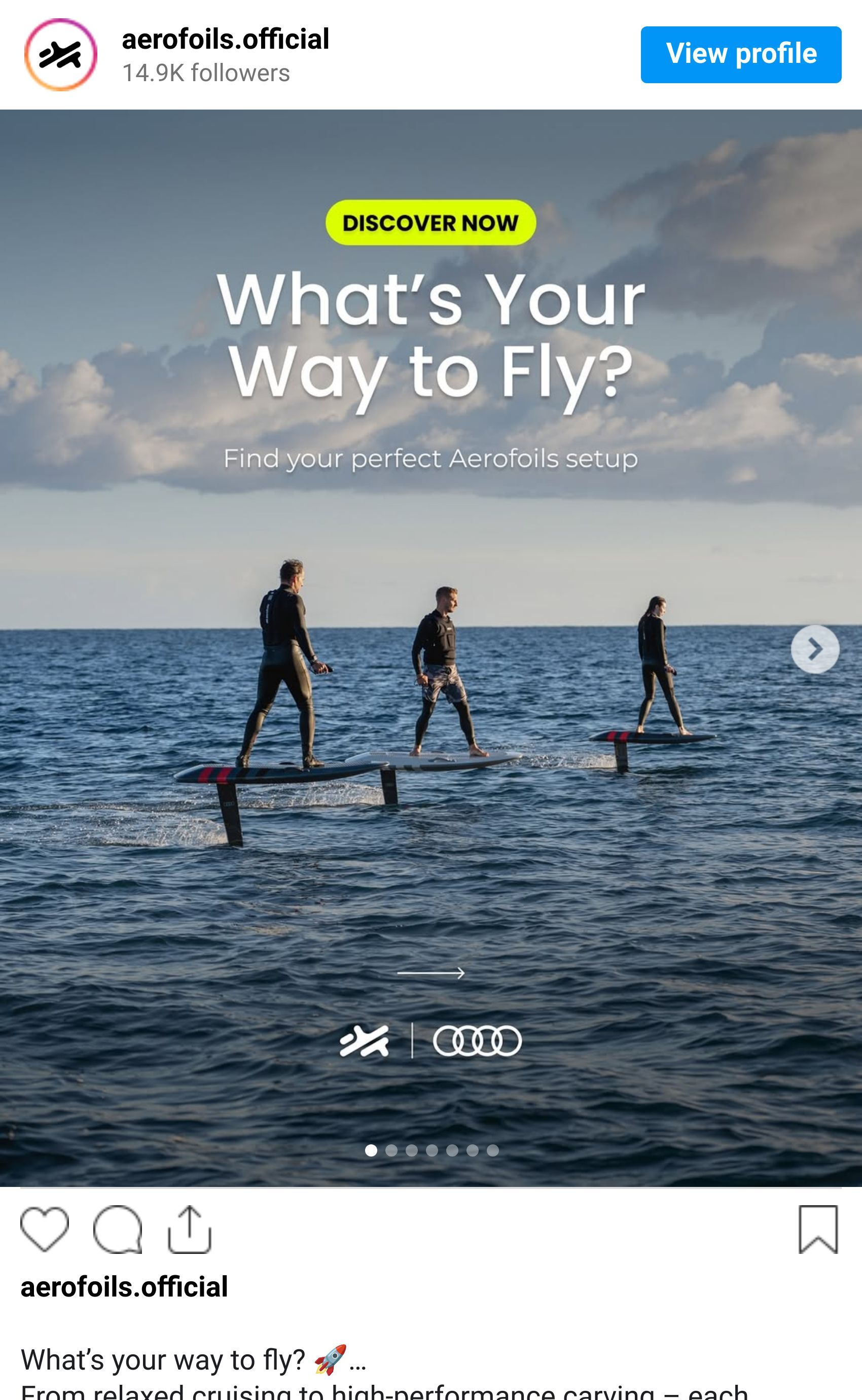
Aerofoils’ expansion into inflatable models underscores that the business is not coasting on legacy inventory. New designs like compact inflatables mark a push toward easier transport and storage while keeping the jet-drive system intact.
🖌️ Vetus Electric Motors
VETUS has been in the marine-systems business since 1964 and now operates under YANMAR’s recreational division, giving it the scale, dealer network, and engineering bench that electric repowers often depend on. Their new E-LINE 22 kW inboard is the strongest motor in their low-voltage electric lineup and is aimed at mid-size displacement and semi-displacement boats up to roughly 15 m or 20 tonnes. It’s positioned as a replacement for a ~30 hp diesel, but with far stronger low-rpm torque and tighter control in close quarters.
The motor is a liquid-cooled, 48 VDC, direct-drive system with a maximum output of 22 kW and a rated continuous output of 20 kW at 1500 rpm. Maximum torque is 130 Nm with a top shaft speed of 1600 rpm. Because it’s direct drive, the motor controller handles all direction changes and deceleration electronically. That makes the system responsive during docking and removes the noise, vibration, and lag of a mechanical gearbox.
Cooling is handled through a closed-loop liquid system using 1/2" connections, and installation can be done with keel cooling or a freshwater-style cooling loop. The motor sits in an IP65 housing with additional splash protection, which aligns with real engine-room conditions.
Electrically, the system draws up to 580 A at 48 V, which requires heavy-gauge cabling, short runs, and careful attention to voltage drop. VETUS includes battery-protection logic, range-management controls, and a 24 V to 48 V boosted charging capability to help bridge existing DC systems with the propulsion bank.
Two operating modes—ECO (up to 1200 rpm) and POWER (up to 1600 rpm)—give operators a built-in range governor and a full-power mode for pushing against wind, current, or tight harbor conditions. A CAN-based monitoring suite covers temperature, current draw, battery level, and warnings, creating a familiar “engine panel” experience for owners transitioning from diesel.
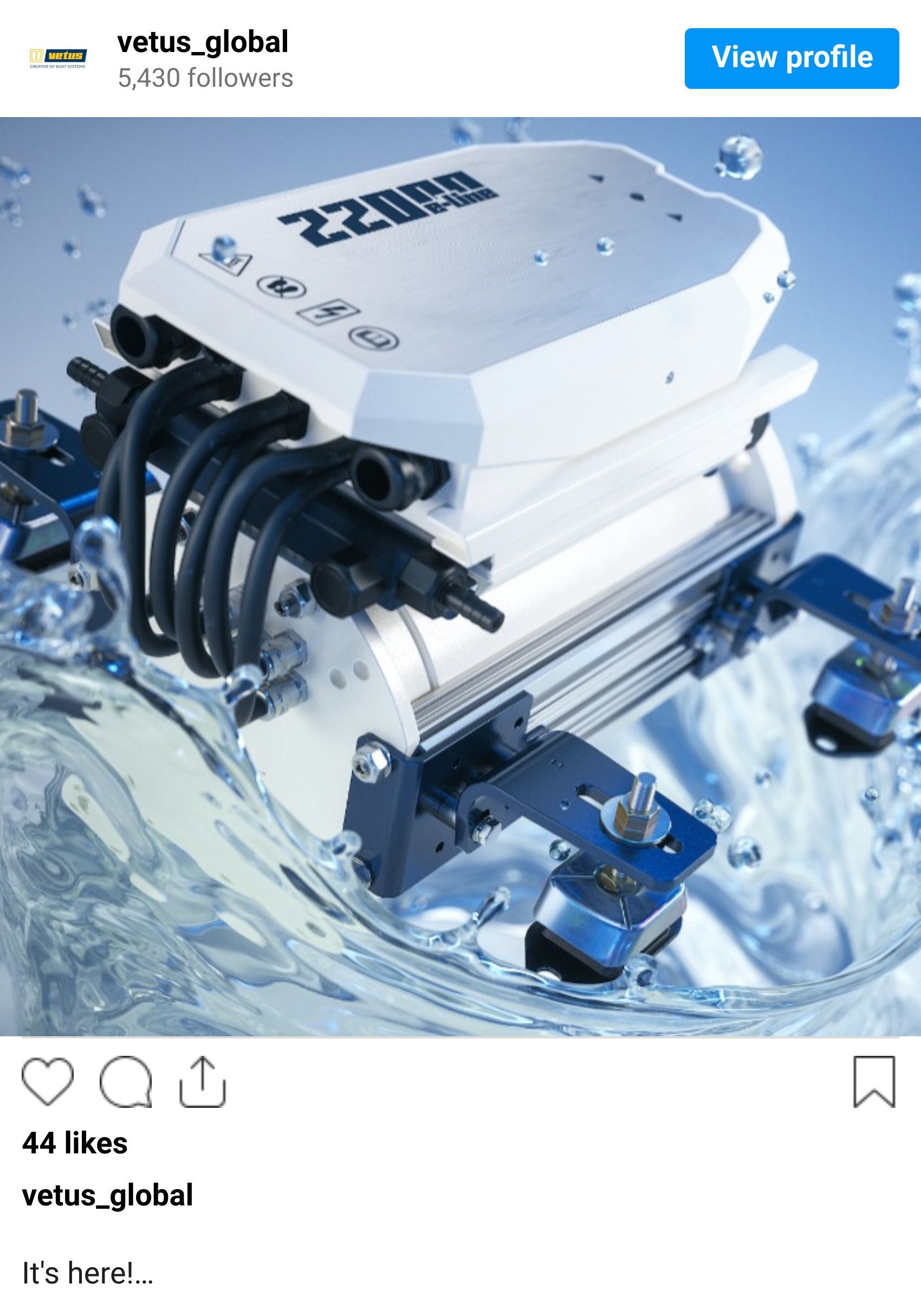
At 93 kg with a compact footprint, the unit is designed to drop onto standard engine beds with common flexible-coupling options. It fills a valuable gap in the market: a dealer-supported, liquid-cooled electric inboard with enough power for real cruising without jumping to high-voltage architectures.
🛝 Social Media Post of the Week
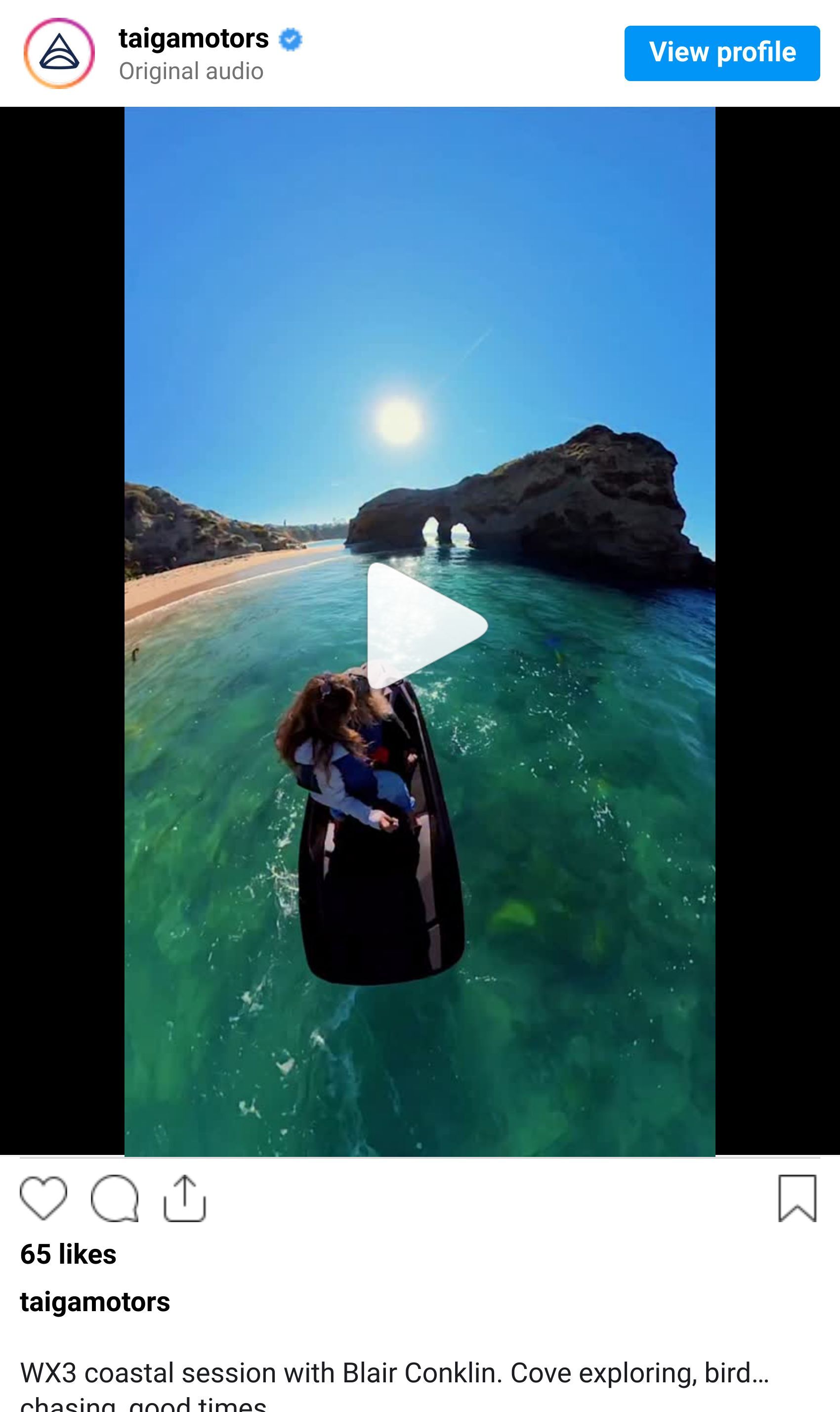
In the midst of a cold snap (aka polar vortex), a sunny ePWC video.
If you are finding this newsletter interesting or valuable, please help us by sharing this on social media and/or forwarding the registration link to a friend or colleague.
