Sponsored by

How 2M+ Professionals Stay Ahead on AI

AI is moving fast and most people are falling behind.
The Rundown AI keeps you ahead of the curve.
It's a free AI newsletter that keeps you up-to-date on the latest AI news, and teaches you how to apply it in just 5 minutes a day.
Plus, complete the quiz after signing up and they’ll recommend the best AI tools, guides, and courses — tailored to your needs.
Not a subscriber? Join here for free.
In this issue:
Arc Sport at Sail GP NYC — evening demo, May 29
Taiga Orca WX3 — new three-seat model now shipping, plus a summer demo tour across North America and Europe
Electric outboards at the National Schools Regatta, Dorney Lake
Naut's Ngaru — New Zealand's 300hp turn-key electric boat
🏄🏾♂️ Arc Sport at Sail GP NYC — May 29
Arc Boats will be at Sail GP in New York on the evening of May 29, and if you're anywhere near Jersey City it's worth showing up.
The Arc Sport will be on site at Sail GP NYC from 5pm to 10pm, set against the Manhattan skyline — come for the racing and check out the boat up close. Sail GP already delivers some of the fastest sailing on the planet; the Arc Sport is a different kind of fast — a 100% electric wake boat with five to six hours of cruising range, no fumes, and a 226 kWh battery pack built in-house.
It's a good pairing. Both are making the case that the performance end of water sports doesn't need to run on fossil fuels. RSVP is required and slots are limited.
Learn more here (scroll down to Sail GP item).
🌊 Taiga takes the Orca WX3 on the road — and the water
The Orca P2 sold out in Q1. Taiga is now shipping its new WX3 to customers in North America and Europe, and in June the company kicks off a summer demo tour so anyone who hasn't ridden electric can find out what they've been missing.
The Orca WX3 Summer Tour starts in June across boating and waterfront destinations in North America and Europe, with details and ride bookings available at taigamotors.com. It's a smart move — the craft sells on sensation, and sensation is hard to convey in a spec sheet.
The WX3 is Taiga's new three-seat model, sitting alongside the updated two-seat P2. The WX3 is built on a versatile crossover platform designed for multi-passenger riding and tow sports, with up to two hours on the water per charge. Its extended hull was hydrodynamically engineered for stability whether cruising or casting off the rear deck.
New for the 2026 lineup: onboard mapping, geo-fencing, and digital key sharing — three features Taiga claims are industry firsts. Riders can set custom speed and power limits, which makes the platform practical for families, rental fleets, and tour operators running mixed-ability groups.
The charging story has also got better. All 2026 models come standard with DC fast charging, bringing charge times down to around 30 minutes — enough time to grab lunch and get back out. For the first time, the Orca supports bidirectional charging, letting owners use it to power homes, yachts, or off-grid cabins.
Taiga came back from a difficult 2024 — production stopped after a mild winter and a tough economy — but the company completed restructuring and was acquired by a group that includes Vita, Evoy, and Aqua Superpower, three names with serious standing in marine electrification. The P2 sellout in Q1 suggests the market moved on with them.
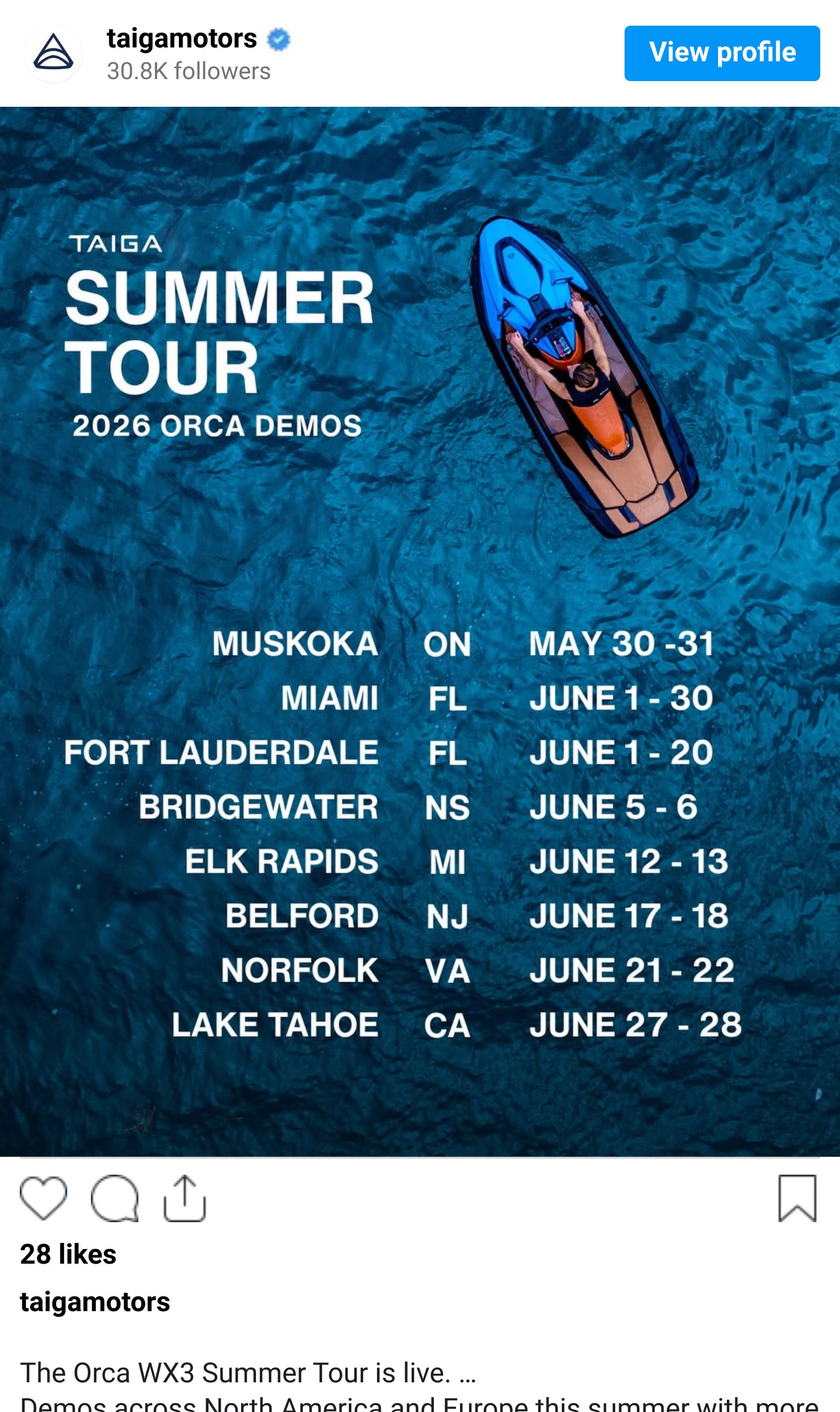
CEO Sam Bruneau called the WX3 "incredibly fun, silent and meaningful progress towards accessible electric boating," adding that bringing it to production so quickly was down to the work of the Taiga team and its partners.
Read more about their world tour, here.
⚙️ Electric outboards at the National Schools Regatta
The National Schools Regatta returned to Dorney Lake this weekend after a year at Nottingham, and with it came the familiar noise problem — or rather, the welcome absence of it when electric launch motors are running alongside the crews.
The regatta moved to Eton College's Dorney Lake for at least five years starting with 2026, following a review of the 2025 event at Nottingham, where racing was disrupted by poor weather and capacity issues. Dorney gives the event room to breathe — and room for thousands of junior rowers competing across a full weekend of heats and finals.
Electric outboards have been creeping into rowing's coaching launch fleet for years, and the logic is obvious: coaches spend hours alongside athletes in small, low-speed craft, often in enclosed waterways. The fumes and noise of a petrol motor aren't just unpleasant — they interfere with communication and, over a career, with hearing.
The shift to electric in a coaching context is different from recreational boating. Range anxiety matters less when you're covering 2,000 metres repeatedly on a closed course. What matters is torque at low speed, quiet operation, and reliability across a long competition day. Modern electric outboards — the ePropulsion Navy series, Torqeedo's Cruise range, and high-power units from Evoy — handle all three without much fuss.
The NSR draws crews from across the UK and Ireland. The event develops lasting partnerships with sponsors and partners to improve the experience for junior competitors each year. Electrification of the support fleet fits that mission — the less engine noise on the water, the better the racing environment for athletes who need to hear their coxes.
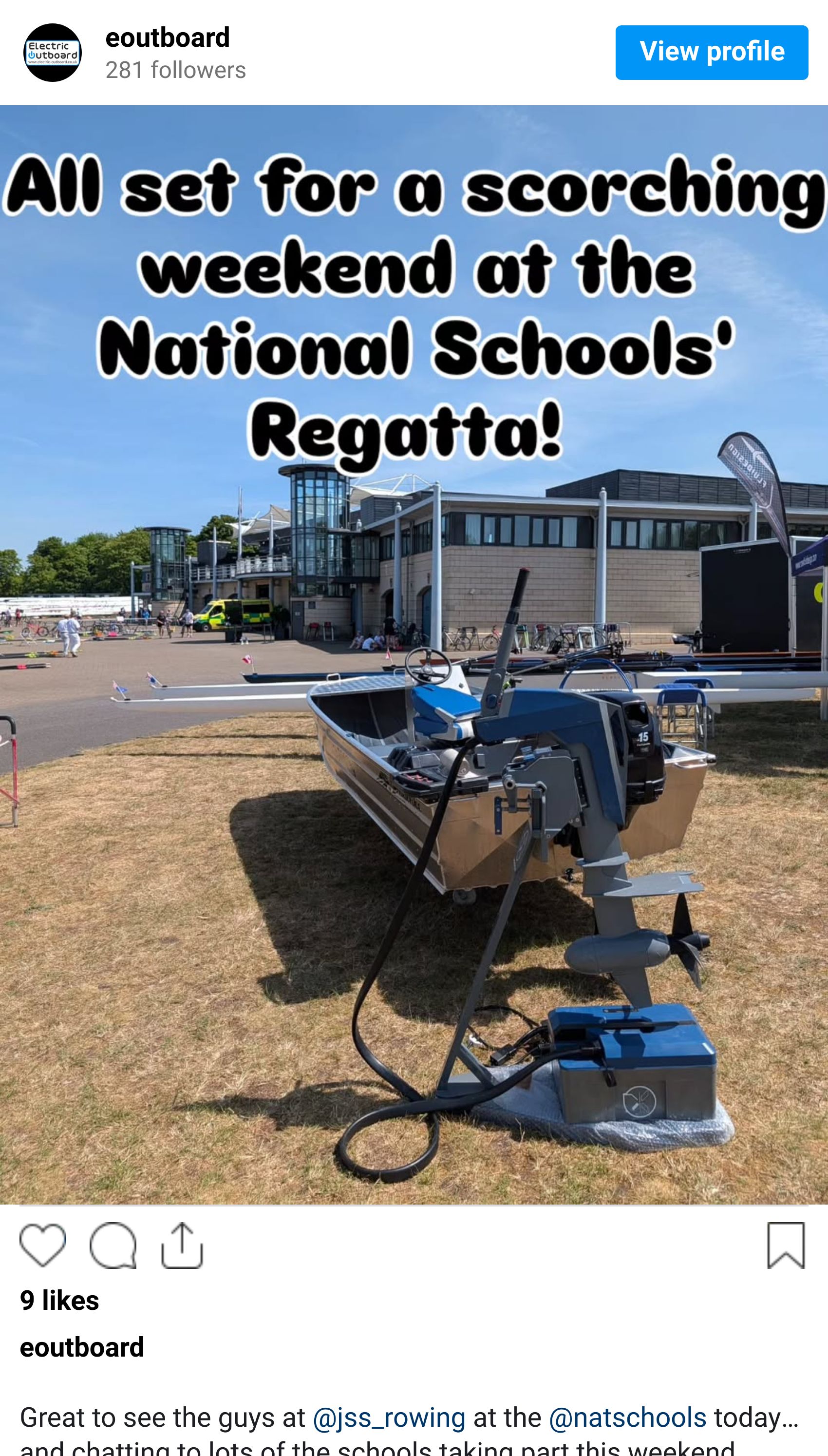
If you're a club or school looking at electric outboards for coaching launches, the NSR fleet is worth watching. The real-world data from a weekend of sustained use at a major event is more useful than most spec sheets.
Read more, here.
🛝 Ngaru — New Zealand's 300hp electric boat gets serious
New Zealand has been quietly building something worth paying attention to. Naut, the Whangārei-based electric propulsion company, launched the Ngaru this year — a turn-key electric boat that puts 300hp of continuous power through a Konrad 560 duo stern drive and reaches 40 knots.
Naut commissioned the Ngaru design, built by Harbour Boat Works, to demonstrate its third-generation electric propulsion system. CEO Fiona Bycroft co-founded the company, and the focus is selling the propulsion system to boat builders rather than competing as a boat brand. The Ngaru is essentially a very fast argument for what the system can do.
The range figures are credible. At 20 knots, you're out for around an hour and a half. Drop to five knots and you have all day — approximately 100 nautical miles. With ideal conditions, the system is rated up to 150 nautical miles on the Ngaru design.
The spec sheet: 300hp continuous, 525hp peak, two 63kWh battery packs giving 126kWh total, cruising speed of 25 knots. Built-in Wi-Fi, live video streaming, and support for underwater drones come standard, alongside a modular deck layout and hand-finished interior.
The market Naut is targeting is specific: superyacht tenders, island transport, and premium recreational boating. Those buyers care about range, reliability, and not smelling of diesel when they come back to the mothership. Electric ticks all three boxes in a way that's hard for a traditional petrol tender to match.
At the 2026 Auckland Boat Show in March, Naut presented the Ngaru as its first market-ready, fully electric boat package, with the vessel on the water at Marina M46. For the company, that show was the commercial milestone — from system development to complete boat integration.
For more information, visit their website here.
If you are finding this newsletter interesting or valuable, please help us by sharing this on social media and/or forwarding the registration link to a friend or colleague.
