Not a subscriber? Join here for free.
This week:
Navalia Tender 750 Hybrid — Dutch aluminum tender with electric running and a combustion backup for when range matters.
Ilmor ION 6 — Premium 6 kW outboard from a racing engine brand, with touchscreen control and hydraulic trim.
GreenStar Marine — Swedish inboard repower kit turning old diesel sailboats into quiet electric cruisers.
eBoat Directory picks — Voltari 260, RaceBird, Princecraft Brio Electric, and Narke GT95.
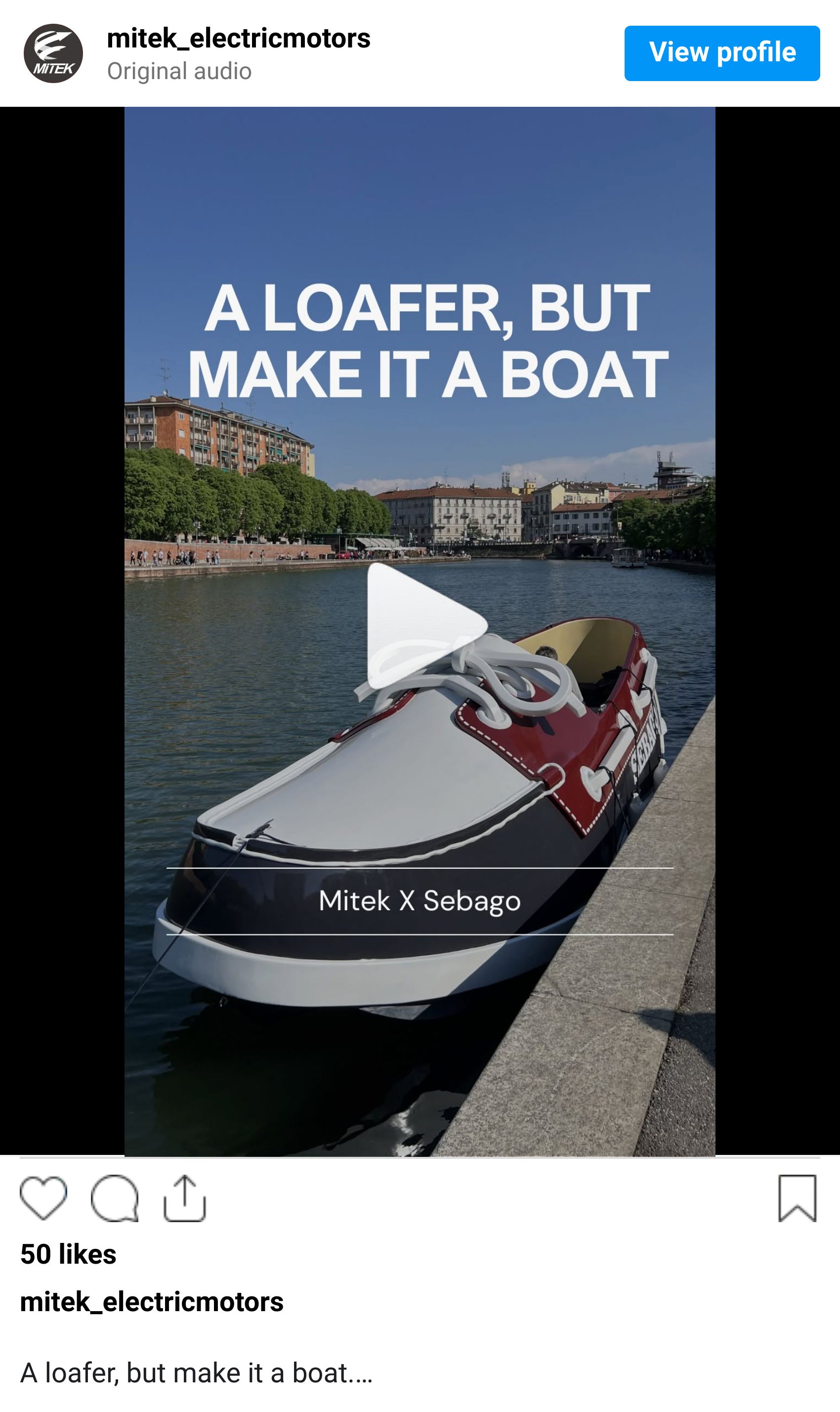
Social Media post of the week - If the shoe fits.
⚓️ Navalia Tender 750
Navalia’s Tender 750 Hybrid sits in a useful middle lane for electric boating. It is not a pure-electric canal cruiser, and it is not a conventional fuel tender with a green label attached. It is a Dutch aluminum tender built for owners who want silent electric running for slow-speed cruising, with a combustion engine available when range, weather, or timing makes electric-only boating less practical.
Many boaters like the promise of electric propulsion but still worry about getting home, charging access, and how the boat will perform beyond short harbour runs. Navalia answers that concern with a hybrid format: electric propulsion for quiet operation, plus fuel power as a backup and range extender. For inland waterways, city cruising, lakes, and family day trips, that is a sensible bridge product.
The boat itself is the Navalia Tender 750 platform, a 7.50-metre aluminum tender with a 2.40-metre beam and seating for up to eight people. Navalia markets the Tender 750 family as customizable, with versions offered as fuel-powered, electric, or hybrid. The hull is aluminum, with a self-draining cockpit floor, checker-plate flooring, rubber fendering, navigation lights, swim ladder, mooring hardware, and CE certification included in the standard equipment package.
The hybrid page does not publish a full technical breakdown of the electric motor, battery capacity, charging time, fuel engine rating, or combined range. That should be stated plainly. Navalia says the hybrid model combines electric and fuel-powered propulsion and uses a brushless hybrid motor that it describes as maintenance-free, but the public page does not provide enough data to compare it directly with electric systems from builders that publish battery kilowatt-hours, motor output, and charge profiles.
The related Navalia Tender 750 Electric gives useful context for the platform. Navalia lists the electric version with an ePropulsion 6.0 kW motor, a top speed of 12 km/h, and charging through a standard 230-volt connection. The company says one battery charges in about 4.5 hours, while two batteries take about 9 hours. It also offers a dual pod motor configuration with two 6 kW motors for 12 kW total output, requiring a 16.8 kWh battery pack. Those figures should not be assumed to be identical for the hybrid model, but they show the kind of electric architecture Navalia is building around the 750 hull.
That makes the boat less pure, but more practical. For the current market, that trade-off has value. Many buyers are not choosing between electric and gas as an ideology. They are choosing a boat that fits how they use the water. A hybrid tender gives them a low-noise electric experience without forcing every trip to depend on charger access and battery state.
Still, the Tender 750 Hybrid points to a part of the electric boat market that deserves more attention. Full electrification gets the headlines, but hybrid propulsion may be a stronger fit for buyers who want cleaner, quieter boating without giving up familiar range. For tenders and dayboats, that could be a durable adoption path.
Read more, here.
🏄🏾♂️ Ilmor ION 6
Ilmor’s ION 6 is a different kind of electric outboard story. It does not come from a marine startup trying to prove it can build propulsion. It comes from Ilmor, a company better known for racing engines, recreational marine powertrains, and engineering work across performance applications. That background gives the ION 6 a useful tension: a quiet 6 kW electric outboard from a brand built on combustion horsepower.
The ION 6 is aimed at small-boat owners who want electric propulsion without the bare-bones feel that still defines part of the category. Ilmor positions it as a premium 48-volt electric outboard for tenders, inflatables, small runabouts, pontoons, and lake boats where low noise, dock control, and clean operation count more than high-speed range. It is not a high-horsepower replacement for a gas outboard on a large planing hull. It is a refined small-boat motor with design and integration as the selling point.
The technical package is straightforward. The ION 6 produces 6 kW of power from a brushless DC motor and runs on a 48-volt system. The motor weighs 32 kg, or 70 lb, and uses direct drive. Shaft options are 25 inches, 30 inches, and 35 inches. A three-blade 10.8-inch-pitch propeller is standard, with an optional five-blade 8.4-inch-pitch propeller available. Control is by remote throttle, and the motor includes integrated electric hydraulic tilt and trim with a tilt range from 9 to 73 degrees.
The ION battery pack is a 4.4 kWh lithium-ion NMC unit with 50.4 volts nominal voltage, 58.8 volts maximum voltage, and 35 volts minimum voltage. Battery mass is listed at 32 kg. The pack uses CAN bus communication, an aluminum housing, IP65 protection, an advanced battery management system, and integrated safety redundancy. Ilmor lists a three-year battery warranty. The company also says the system can use lithium or lead-acid battery configurations, though the published ION battery data gives the clearest view of the intended setup.
Range is where the ION 6 needs the usual electric-boating caveat. Ilmor publishes performance data from a Highfield 360e using the Ilmor ION battery pack: 40 minutes and 9.3 miles at full throttle, four hours and 17.6 miles at half throttle, and 11 hours 26 minutes and 34.3 miles at slow speed. Those numbers are helpful, but they are not universal. Hull weight, load, wind, current, propeller selection, bottom condition, and speed choice will shape real-world results. The more useful takeaway is that the ION 6 rewards displacement-speed boating. Push it hard and the battery drains. Run it as a tender, harbour cruiser, or quiet lake motor and the range picture changes.
Ilmor also made the ION 6 feel more like a modern consumer product than a utility motor. It includes an integrated touchscreen helm display, keyless activation through a passcode, RGB lighting, and built-in hydraulic tilt and trim. Some boaters will see the lighting and styling as excess. Others will see the point: electric outboards are moving beyond the plain transom-mounted motor and into designed systems meant for premium small boats.
The strongest case for the ION 6 is not raw output. Six kilowatts is a compact power class. The stronger case is integration. A 48-volt electric outboard with remote throttle, hydraulic tilt and trim, direct drive, touchscreen control, a matched battery option, and support through Ilmor’s marine network gives the product a more complete ownership proposition than many small electric alternatives.
Legacy engineering brands are entering with narrower, more polished products. The ION 6 may not be the motor that converts every boater, but it helps define where the market is going: cleaner propulsion, better controls, and electric systems that feel built for boating rather than adapted to it.
Read more, here.
🌊 GreenStar Marine
GreenStar Marine is not chasing the portable outboard market. Its GreenStar electric motor line is built around inboard conversion: replacing small diesel engines in sailboats, displacement cruisers, harbour craft, and workboats with a complete electric drivetrain from propeller to shore-power connection.
The company now operates under GSM Electric AB in Sweden, but the GreenStar name remains attached to the product line. Its current site positions GreenStar as an electric inboard system for boat owners changing engines, with EB-Line, EC-Line, and P-Line options. EB-Line is the more basic setup, EC-Line is the complete system, and P-Line uses the same electrical architecture as EC-Line with a more powerful motor package. EC-Line and P-Line also connect to STAR, GSM Electric’s cloud service for monitoring and updates.
The practical appeal is the scope of the system. GreenStar is not just a motor bolted into an old engine bay. The EC-Line package includes the motor and mounting, fixed propeller, shaft hardware or saildrive depending on configuration, common connection box, central unit with antenna, speed control, basic system monitor, battery charger, cables, shore-power system, and STAR cloud service for two years. That makes the product closer to a repower kit than a standalone component.
The EC-Line specifications show where GreenStar fits. The E10 uses a brushed DC motor with 3.2 kW continuous input power and 4.8 kW maximum input power. The E20 raises that to 5.2 kW continuous and 7.8 kW maximum. Both run at 24 volts, use air cooling, and turn at 1,000 rpm. Torque is listed at 25 Nm continuous and 37 Nm maximum for the E10, and 40 Nm continuous and 60 Nm maximum for the E20. Maximum static thrust is 100 kp for the E10 and 180 kp for the E20. Shaft-drive weight is 25 kg for the E10 and 32 kg for the E20; saildrive versions weigh 38 kg and 45 kg. GSM Electric lists diesel-equivalent ratings of 10 hp and 20 hp.
GreenStar’s power ratings look modest beside high-output electric outboards and planing-boat systems, but that is not the point of this product. The target customer is more likely replacing an auxiliary diesel in a sailboat than trying to run a fast dayboat. For that use case, low-speed torque, dock control, system integration, shore charging, and lower maintenance carry more weight than headline horsepower.
The current GreenStar line also reflects a shift in electric marine adoption. The early market was filled with small trolling motors and high-profile performance launches. Inboard repowers sit between those extremes. They are less glamorous, but they address a large installed base: older sailboats and displacement hulls with aging diesel engines, owners who want quiet operation, and marinas where fumes, maintenance, and winterization are part of the ownership calculation.

Source - EC-Line website
For electric boating, GreenStar is a reminder that adoption will not come only from new hulls. A large part of the transition will happen inside existing boats, one engine bay at a time. The strongest case for GreenStar is not novelty. It is a cleaner repower path for boaters who already like their hull, but are finished with the noise, vibration, and service burden of a small diesel.
Read more, here.
⚙️ eBoat Directory Listings of the Week
Voltari 260 — A high-performance 26-foot electric powerboat built for speed, range, and premium day boating, with a deep-V carbon-fibre hull and fully electric propulsion. Link.
RaceBird — The electric hydrofoiling race boat used in the E1 Series, designed to lift above the water and showcase the future of high-speed electric marine competition. Link.
Princecraft Brio Electric — An electric pontoon boat series from Princecraft aimed at quiet, low-maintenance cruising for lakes, cottages, and relaxed family boating. Link.
Narke GT95 — A fully electric personal watercraft with a 95-horsepower electric jet drive, built for quiet, emissions-free riding with a premium design profile. Link.
📅 Social Media Post of the Week
If the shoe fits, why not make it electric?
If you are finding this newsletter interesting or valuable, please help us by sharing this on social media and/or forwarding the registration link to a friend or colleague.
