In partnership with

Issue 127. Not a subscriber? Join here for free.
🛝 Range Anxiety and eBoat Positioning
Andrew Sell’s point in “AI just entered the meaning war. Electric boats are next.” is that frontier tech categories mature in a predictable way: first they compete on capability, then they compete on what the capability means in a person’s life. He uses the shift in AI marketing as the template—when tools start to look alike, the winner becomes the brand that frames the choice in human terms, not product terms.
He argues electric boating is approaching that same inflection. The industry still defaults to the engineering conversation—range, speed, battery size, charging curves—because those are measurable and defensible. But the purchase decision is shaped by a different set of fears and expectations: “Will this fit into my weekends?” “Will this create friction?” “Will I regret it when something goes wrong?” The claim is that the emotional questions are rising while the engineering questions fade into baseline competence.
That framing matters because it explains why two electric boats with similar specs can perform very differently in market pull. Spec parity compresses differentiation. The remaining gap is confidence. Not hype, not novelty—confidence that the boat will behave like a normal part of life. In practice, that means the buyer wants a clean mental model: what range looks like in their water, what charging looks like at their marina, what winter storage looks like, what service looks like, what failure looks like, and how fast “back on the water” can happen.
Sell’s best line is that marine EV is “arguing kilowatts while buyers are worrying about weekends.” That is a diagnosis of messaging mismatch, not product weakness. If the category communicates only in technical abstractions, it forces buyers to translate those abstractions into lived experience on their own. Most people will not do that translation. They will default to the familiar option, even if the unfamiliar one is objectively better on paper.
Range anxiety fits inside this, but it is often misunderstood. The fear is not usually “I will run out of electrons and drift forever.” For most day boating patterns—short runs, time at anchor, a loop back to the dock—range is workable if the product is honest about real cruising profiles and reserves. The bigger issue is uncertainty. People hesitate when they cannot predict how the system behaves under load, chop, wind, current, cold temperatures, or passenger count, and when they do not know what the boat will do when the plan changes. Range anxiety is a proxy for “I don’t trust the edges.” When the edges become legible—clear reserve guidance, clear consumption feedback, clear reroute options, clear charging plan—range becomes a planning variable, not a panic trigger.
A useful comparison is the shift that happened in EV cars. Most drivers stopped worrying about “running out” once the interfaces taught them the basics: consumption moves with speed, temperature matters, chargers exist but require planning, and arriving with a buffer is normal. The learning curve is not complex; it is unfamiliar. Electric boats can compress that learning curve with better instrumentation and better onboarding. The goal is not to promise unlimited range; it is to make range predictable.
This is where the “meaning war” concept lands: the winner is the brand that makes electric boating feel dependable and routine, not futuristic and fragile. That can show up in product design—simple charging, robust connectors, a battery system that communicates state clearly, fault handling that degrades gracefully, and service pathways that feel human. It can also show up in the story: not “the future of boating,” but “the end of hassle.” Silence and torque are benefits; reduced stress is the outcome.
If electric boating is heading into a meaning war, the battleground is not speed. It is reassurance. The strongest brands will build trust through clarity: clear real-world range tables, clear use cases, clear charging workflows, clear ownership costs, clear service coverage, and clear recovery plans when something breaks. Specs will remain necessary, but they will stop being persuasive on their own. The persuasive layer will be the buyer’s ability to picture a normal week with the boat—and feel good about it.
Read Andrew’s article, here.
⚙️ Momentum Electric Marine U-2
Momentum Electric Marine is aiming the U-2 at the part of the market where gas has stayed stubborn: portable “5 hp class” outboards for tenders, small inflatables, sailboat auxiliaries, and light workboats. The hook is simple: 2.5 kW max input power packaged with an integrated, removable battery and the handling profile of a grab-and-go motor, not a lift-with-two-hands block of metal and fuel.
The U-2 drive unit is rated at 2.5 kW input and uses external passive seawater cooling. Prop hardware is a 25 cm diameter, 2-blade propeller. Two shaft options are offered: 39 cm short or 52 cm long (transom-to-prop tip measurement with the leg vertical). The motor system is built around a 1.4 kWh battery that carries the trip computer, including GPS, so the display and range logic travel with the pack. Total system weight is listed at 17 kg (short stem) or 17.5 kg (long stem) for the outboard assembly with prop, plus a 2 kg mount.
Control and rigging details are where the U-2 separates itself from many small electrics. The tiller folds away and serves as a carry handle. A safety button is included alongside a steering lock. The mounting clamp is a quick-release design intended to make install/removal a dockside task. A magnetic kill switch is included. On the electrical side, Momentum specifies an integrated CAN bus interface between outboard, battery, and throttle, along with IP-rated waterproof connectors. For helm control, the U-2 is set up to pair with Momentum’s MT-1 top-mount or MT-2 side-mount remote throttle, supporting remote steering configurations.
Momentum publishes on-water performance tables tied to specific inflatable hulls with one person aboard in calm coastal water. On an Ezraft Q360, the published points are 3.0 knots for 18.3 hours and 55 nm, 4.0 knots for 3.3 hours and 13 nm, 5.0 knots for 1.5 hours and 7 nm, and 9.0 knots for 0.6 hours and 6 nm. On a Takacat T300LX, the published points are 3.0 knots for 9.7 hours and 29 nm, 4.0 knots for 3.0 hours and 12 nm, 5.0 knots for 1.6 hours and 8 nm, and 8.0 knots for 0.8 hours and 6 nm. On a Highfield Classic 310, the published points are 3.0 knots for 7.7 hours and 23 nm, 4.0 knots for 2.3 hours and 9 nm, 5.0 knots for 1.0 hour and 5 nm, and 6.0 knots for 0.7 hours and 4 nm. Those numbers reinforce the core positioning: endurance at displacement speeds, plus a burst envelope that can push certain light inflatables into the 8–9 knot range when hull and load permit.
What this adds up to is a 5 hp-class electric outboard built around portability without giving up core safety and rigging features that matter on small boats: kill switch, reverse/power lockouts via safety logic, waterproof connectors, and a clamp-and-go mounting system. If Momentum’s published performance maps to your hull, the U-2 sits in a narrow sweet spot: enough power to handle wind and current on a loaded tender, while keeping the carry, stow, and swap workflow closer to a piece of gear than a piece of machinery.
Read more on their website, here.
⚓️ eBoat Directory Listings of the Week
EF-12 Escape – Born from America's Cup technology, the Artemis EF-12 Escape is a 100% electric hydrofoil water taxi carrying 30+ passengers at 30 knots. Link
Electric Retractable Pod – BlueNav's electric retractable pods provide 25 horsepower equivalent thrust with enhanced maneuverability via joystick control and an innovative retractable design to reduce drag. Link
Edorado 8S – The Edorado 8S is a luxury electric hydrofoil powerboat that flies above the water, offering a smooth ride and 38-knot top speeds. Link
Fliteboard Series 3 – Fliteboard Series 3 is the world's most advanced eFoil, allowing you to fly over the water for up to 150 minutes per charge without any need for waves or wind. Link
📅 Social Media Post of the Week
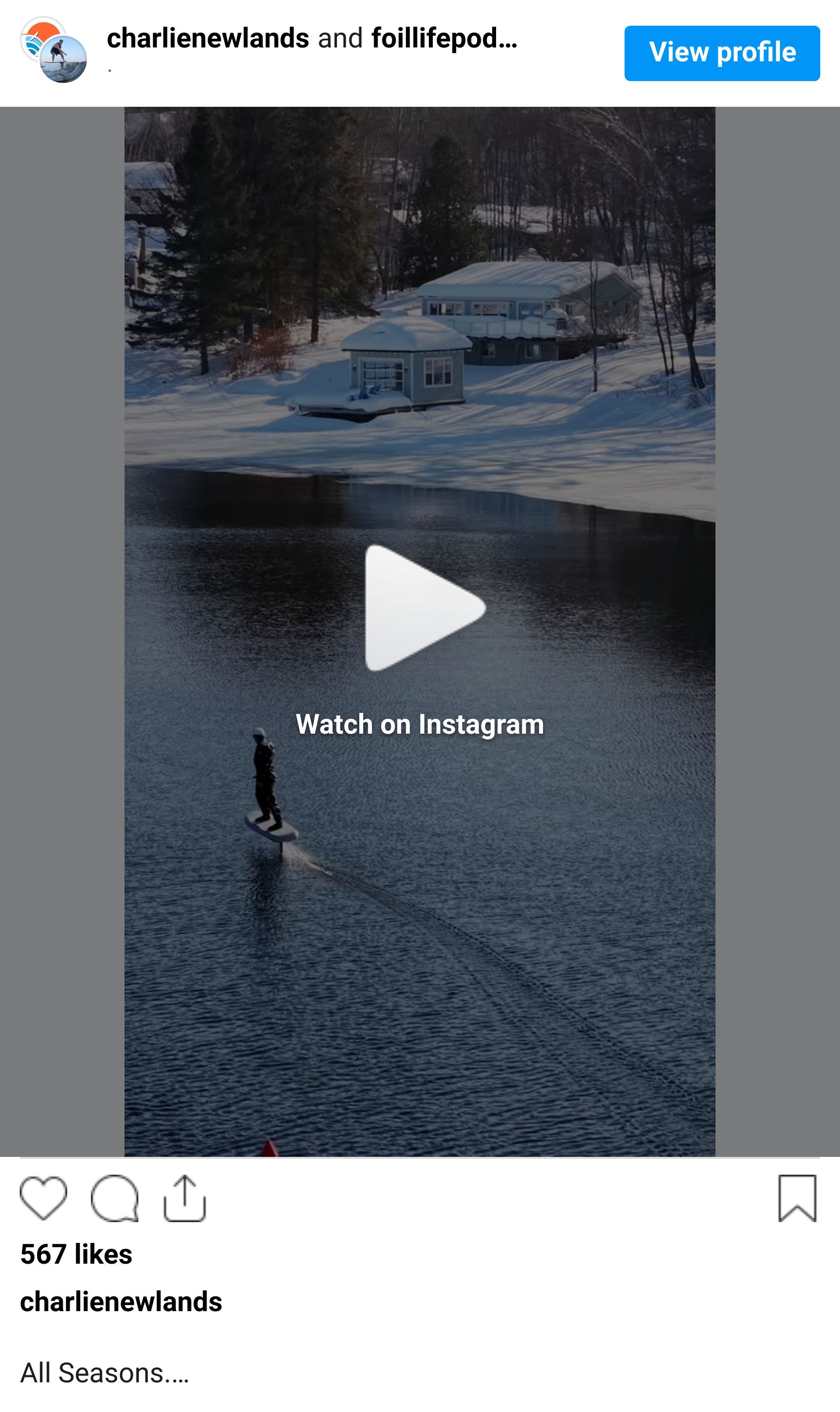
Why wait for summer? eFoil all year round.
Dictate code. Ship faster.

Wispr Flow understands code syntax, technical terms, and developer jargon. Say async/await, useEffect, or try/catch and get exactly what you said. No hallucinated syntax. No broken logic.
Flow works system-wide in Cursor, VS Code, Windsurf, and every IDE. Dictate code comments, write documentation, create PRs, and give coding agents detailed context- all by talking instead of typing.
89% of messages sent with zero edits. 4x faster than typing. Millions of developers use Flow worldwide, including teams at OpenAI, Vercel, and Clay.
Available on Mac, Windows, iPhone, and now Android - free and unlimited on Android during launch.
If you are finding this newsletter interesting or valuable, please help us by sharing this on social media and/or forwarding the registration link to a friend or colleague.
