Subscribe here for free.
🏄🏾♂️ Open Waters Solar Wins Beaver's Den
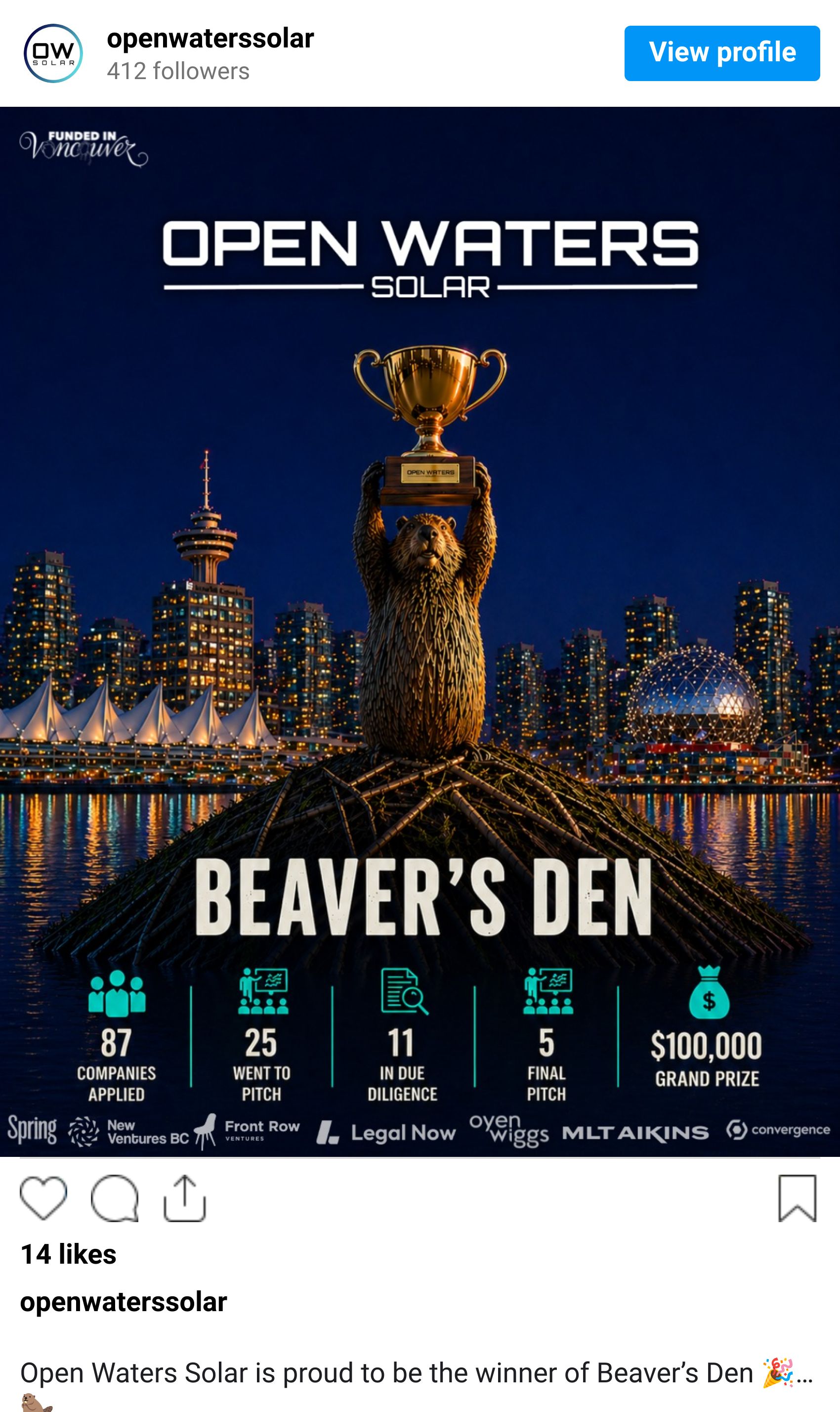
Open Waters Solar, a marine solar panel manufacturer based in Prince George, British Columbia, has won the inaugural Beaver's Den pitch competition, taking home $100,000 in the process.
Beaver's Den is a new pitch event produced by Funded in Vancouver, modelled on the Dragons' Den and Shark Tank format. The inaugural edition drew 87 companies. Twenty-five advanced to pitch. Eleven moved into due diligence. Five reached the final stage. One won.
Open Waters Solar was that company.
The business started not as a solar company but as a boat builder. Founder and CEO Simon Angus set out to build an all-electric sailing catamaran — the ESC40 — and ran straight into a problem shared by the wider marine industry: solar panels designed for rooftops perform poorly on boats. They crack under the flex and vibration of a hull underway. Shading from a mast or rigging throttles an entire array. And standard rectangular panels waste the irregular deck space that most vessels actually have.
Angus spent over 18 months in research and development before producing what the company calls a composite marine solar panel — lighter and more durable than conventional flexible panels, with additional bypass diodes engineered in so that shading one section of the array no longer kills output across the rest. Custom shapes are available through a growing network of installation partners, which matters for boat builders trying to maximize solar real estate without compromising the look of a vessel.
The Beaver's Den win comes on the back of real commercial traction. Open Waters Solar noted that this was their second time reaching the final stage of this competition — previously under the Startup TNT banner — and that they came back with a more developed data room and clearer commercialization story. That showed.
For electric marine, a Canadian company winning a $100,000 pitch competition on the strength of marine-specific solar technology is worth paying attention to. The charging problem for electric boats is real. Range anxiety on the water is real. Solar that actually works on a marine platform — without cracking, without shading losses, without wasted deck space — is part of how that problem gets solved.
Read more, here.
🛥️ The Creator Who Spent Three Years Building a Tesla Jet Boat
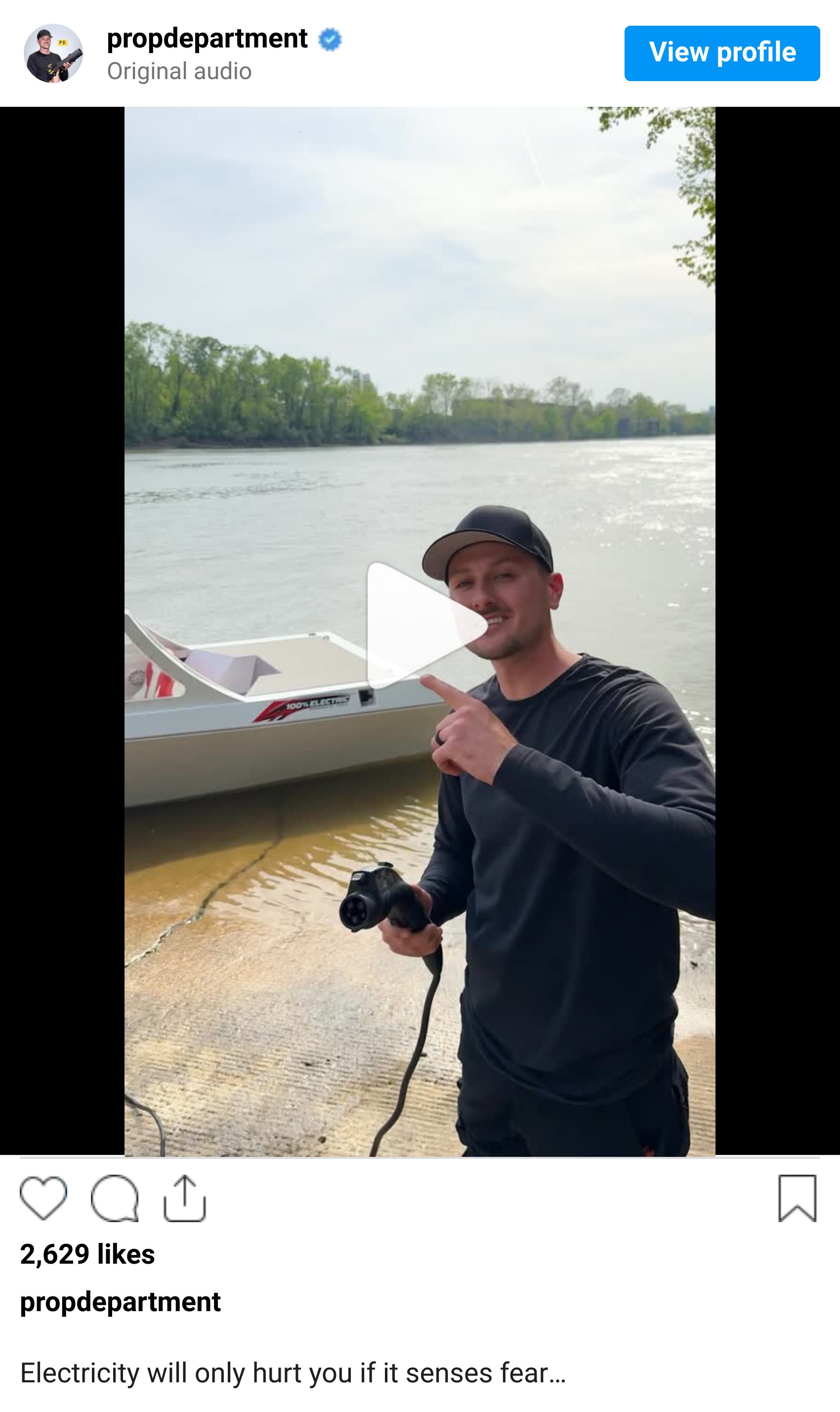
Tyler Fever is a self-described aspiring mad scientist who builds extreme vehicles and robots from his workshop in Nashville, Tennessee — with no engineering degree. His YouTube channel, Prop Department, has 350,000 Instagram followers and 8.4 million TikTok likes. His most ambitious project took three years and ended up on Tubi as a four-episode series. The project was a custom mini jet boat powered by a Tesla motor, built entirely from scratch.
The concept is exactly what it sounds like. Fever pulled a Tesla drivetrain, adapted it for marine use, and built a jet boat around it. Not a conversion of an existing hull. A ground-up build, learning EV engineering in public as he went, with setbacks documented along the way. The first episode opens with the first launch not going as planned. The second covers major upgrades and the first successful lake test. The third episode marks the end of the three-year build — with a significant setback that nearly derails the whole thing. The fourth takes the boat to Nashville for testing.
What makes this worth watching for anyone following electric marine is that Fever is not an engineer, not a marine company, and not working from a kit. He is figuring out how a Tesla motor behaves on water through trial, failure, and iteration. That process surfaces real engineering challenges — thermal management, waterproofing high-voltage systems, jet propulsion dynamics — in a format that is far more accessible than a technical paper or a trade show announcement.
The build has been running on social media across TikTok, Instagram, and YouTube for years, accumulating a following well before the Tubi series landed. The short that surfaced recently on YouTube — the one your newsletter links to — is the compressed highlight reel of a project that took the better part of three years to complete.
The broader context is that creator-led electric vehicle builds have become one of the more effective pipelines for public awareness of EV technology. Builds like Fever's reach audiences that have no interest in industry press releases, trade publications, or boat show coverage. A 30-second short of a Tesla-powered jet boat running on a lake travels faster and further than most marketing. For electric marine, that kind of visibility matters. The people watching Prop Department are not all buying boats today — but some of them will be.
Watch a Youtube video to learn more, here.
⚙️ ACEL Power: The Canadian Company Building Electric Outboards from 50 to 250 HP
ACEL Power was founded in Vancouver in 2021 with a straightforward ambition: build electric outboard motors with enough horsepower to replace gas engines that serious boaters actually use. Four years later, the company has a four-model lineup, $10 million in Series A funding from Tau Capital, and a growing list of boat builders, commercial operators, and distributors putting their motors on the water.
The product line is called the Intelligent Electric Series, or IE Series, and it runs from 50 HP to 250 HP. The IE 50 and IE 75 are in production and available now. The IE 150 is in pre-order. The IE 250 is coming and reservations are open.
What separates ACEL from most electric outboard makers is the voltage and the system approach. The IE 150 and IE 250 run on an 800-volt platform using Silicon Carbide semiconductor technology — the same high-voltage architecture that has pushed efficiency in electric vehicles. At 800 volts, the system can move more power through smaller wires, reduce heat losses, and keep the motors compact relative to their output. The IE 150 is rated at 150 HP with a peak of around 200 HP. The IE 250 is rated at 250 HP with a peak closer to 350 HP.
That peak power matters. ACEL publishes their motors as offering up to 30 percent more output than the nominal rating, which is how electric motors actually work — they can exceed continuous ratings for short bursts, delivering the kind of acceleration a gas engine produces at full throttle. For a boat leaving a dock or pushing through a wake, that burst capacity is what the driver feels.
The company describes itself as a system builder rather than a motor supplier. A full ACEL setup includes the outboard motor, a modular battery pack, a smart charger, an onboard computer, a digital throttle, and a smart key. The onboard computer connects to a companion app that monitors speed, range, battery state, and tilt in real time. ACEL's patented hybrid integration allows the system to link to a secondary power source, which means a boat builder can configure a hybrid setup without replacing the entire drivetrain architecture.
Battery configuration scales with the motor. The IE 50 and IE 75 have been deployed with LFP packs in the 32 to 43 kWh range. The IE 150 is listed with around 86 kWh across four modules. The IE 250 can be configured with six modules, putting total capacity in the 160 to 172 kWh range depending on chemistry. Semi-solid state battery options are listed alongside the standard LFP architecture in ACEL's published specifications.
The commercial track record is building. ACEL's IE 50 powered a Porrima P111 rigid inflatable boat to 29 knots during sea trials last year — a useful proof point that a 50 HP electric outboard can push a planing hull at speeds that recreational boaters expect. In 2025, ACEL also announced a joint development agreement with Vivic Corp, a Taiwanese luxury yacht builder, to power the Vivic EV1 catamaran with twin ACEL inboard motors adapted from the outboard platform. That vessel is described as the first fully electric yacht globally to launch with ACEL's twin inboard powertrain.
The company has flagged a range of 1 HP to 650 HP as its long-term roadmap, which would cover everything from small tenders to commercial workboats. For now, the four IE Series models represent where the product is today: a high-voltage, software-integrated, Canadian-built electric outboard system with enough horsepower to start a real conversation with the gas engine market.
Read more, here.
📅 Upcoming Events
Lake Berryessa Electric Boat Festival — Pleasure Cove Marina, Lake Berryessa, California. June 5–6, 2026. Produced by Sea Watts in partnership with California CORE and Vision Marine Technologies, this two-day festival is positioning itself as the world's largest dedicated electric boat event. More than 15 electric vessel and propulsion participants are confirmed across recreational and commercial sectors. Attendees can ride and drive electric boats on the water. Link
Venice Boat Show — Venice, Italy. The E-Village section of this year's show is dedicated to electric propulsion, hydrofoils, hydrogen, and autonomous vessel technology, and includes the E-Regatta — a live on-water showcase that runs along the Canal Grande. One of the few major European shows treating electric marine as a structural part of the event rather than a side exhibit. Link
Discover Boating Norwalk Boat Show — Norwalk Cove Marina, Connecticut. September 24–27, 2026. A long-running consumer show on the US East Coast that has been expanding its electric and hybrid boat coverage each year. Link
If you are finding this newsletter interesting or valuable, please help us by sharing this on social media and/or forwarding the registration link to a friend or colleague.
