In partnership with

Issue 125. Not a subscriber? Join here for free.
Visiting - clicking the Wispr Flow logo above - this week’s ad helps support this newsletter (…someday keyboards will be a thing of the past - computer input will be via voice).
⚙️ Trident Hybrid Powertrain
One of the more interesting propulsion news out of the 2026 Miami International Boat Show was not a bigger V8 or a new prop—it was a wager that the wakeboat market is ready to treat electrification like a system architecture problem, not a bolt-on accessory. Indmar arrived in Miami with Genesis Marine Technologies to unveil what they’re calling the Trident Hybrid Powertrain and to frame it as a platform play: a production-minded, software-managed hybrid system packaged around the specific realities of wakesurfing—steady high loads, tight speed control, long days on the water, and owners who notice noise, vibration, and fuel stops as much as they notice wave shape.
At the core is a decision that will matter far beyond one boat model: Trident is built as an EV-first series hybrid. That phrase sounds like marketing until you translate it into mechanics. In a series hybrid, the propeller is turned by an electric motor, full stop. The gasoline engine does not connect to the drivetrain and does not “help” by adding torque through a gearbox. Instead, it is used as an auxiliary power unit (APU) whose job is to generate electricity when you need more runtime than the battery alone can provide. The Genesis 24 configuration described publicly uses an Indmar 2.3L EcoBoost engine in that APU role, but the architecture is positioned as modular.
That single design choice cleans up several long-standing compromises in recreational boating. Traditional wakeboats run big gasoline engines at the same part of the map for hours—high load, narrow speed band, heavy ballast—and owners pay the bill in fuel, sound, heat, and maintenance. A series hybrid lets the gasoline engine live a different life: steady-state operation at an efficient point while the electric side handles the fast torque changes that riders feel. The boat becomes, in effect, an electric wakeboat most of the time, with an onboard generator that protects you from range anxiety when the day stretches long or the crew wants “one more set.”
Genesis publishes the headline hardware numbers: a 105 kWh battery pack; peak system output framed as 530 hp and 1,420 lb-ft of torque; and a multi-mode operating concept that allows pure electric running or hybrid charge-sustaining operation. A New Eagle engineering case study (link below) goes deeper on the integration picture and, importantly, treats the controls layer as first-class. It describes a 400 kW electric drive motor delivering torque directly to the prop, coordinated with a range-extender sized at 225 kW, all governed by a supervisory controller that manages operating modes (Pure Electric, Economy, Balanced, Performance), state-of-charge targets, derates, limp strategies, and the choreography of transitions that could otherwise show up as a surf-killing surge or sag.
If you want to understand why this approach feels “new” in a market already full of hybrid badges, focus on what it removes: clutches, shift events, and the mechanical coupling constraints that force compromise. Electric torque arrives with precision, and that precision is the point in wakesports. Holding speed to a tight window under changing load—turns, rider pulls, ballast shifts, chop—has always been a control problem disguised as an engine problem. A high-torque electric machine controlled by software is naturally suited to it. Genesis and its integration partners leaned into that by treating wake quality as a control objective, not a happy byproduct, and by building multiple modes that adjust how aggressively the system uses the battery versus calling on the APU.
The on-water claims give the best window into how the system is intended to be used. In pure electric mode, Genesis says the boat can deliver up to about 90 minutes of silent surf operation while carrying roughly 5,000 pounds of ballast—an important detail, because ballast is the enemy of battery runtime and the essence of a surf wave. In hybrid mode, the claim is all-day usage with typical fuel consumption of 5–10 gallons per day, contrasted against conventional V-drive wakeboats that may burn 40–50 gallons in a day of similar riding. Noise reduction is framed as dramatic as well: preliminary testing cited in the engineering write-up points to reductions of up to 75% versus conventional setups.
Those numbers matter for two reasons. First, they translate electrification into something wakeboat buyers already track: “How many sets did we get?” and “How many times did we hit the fuel dock?” Ninety minutes of silent surf is not a science project—it is a full session that changes the feel of a cove. Second, the hybrid fuel claim, if it holds across real owners and real seasons, is not marginal improvement; it is a reframing of the operating cost and emissions profile of a category that has historically been optimized for performance at any consumption rate.
It is tempting to treat carbon footprint discussions in watersports as virtue signaling because these boats are, by definition, recreational. But the sector’s trajectory will be shaped by a set of pressures that have nothing to do with moral arguments: lake access rules, dockside noise expectations, local air-quality concerns, and the broader electrification of adjacent mobility markets that is training consumers to expect quiet, instant torque, and software updates as normal. A series hybrid like Trident addresses these pressures in a pragmatic way. It cuts fuel burn directly in the most common use case—steady-load surf sessions—by letting the electric system do the propulsion work and by allowing the gasoline engine to operate in a controlled, efficient regime when it’s needed. Less fuel burned per hour means less CO₂ per hour, full stop. It also reduces localized emissions exposure for riders and crews who spend hours near the transom at low speeds, and it lowers noise in the places where wakesurfing actually happens: protected bays, coves, and shorelines.
Indmar’s involvement is worth reading as a signal, not just a supplier logo. Indmar is deeply embedded in wakesports OEM supply chains, and Miami was positioned as a public partnership announcement tied to a specific show presence. When a legacy inboard engine player stands next to a new boat brand and points the spotlight at a hybrid powertrain rather than another displacement bump, it suggests that electrification is moving from “future concept” to “product strategy” in the segments that sell on experience. Wakeboats are unusually sensitive to experience: the sound level during a set, the smoothness of torque delivery, the absence of fumes at idle, the ability to talk at the transom without shouting. A hybrid system that improves those things while also reducing fuel stops has a credible path to adoption even before you factor in regulation.
Source link, here.
🌊 eBoat Directory Listings of the Week
Fliteboard Series 3: Known as the world's most advanced eFoil, this ultra-quiet board allows riders to "fly" over the water for up to 150 minutes per charge at speeds reaching 30 mph. Link
Narke GT95: Often called the "Electrojet," this three-seater personal watercraft features a futuristic carbon-fiber hull and delivers 95 HP of instant electric torque for a high-performance, emission-free ride. Link
E-Motion 180E: A game-changer in propulsion, this is the world's first 180 hp fully electric outboard, offering a high-performance alternative for boaters looking to pair silent operation with extreme power. Link
Racebird: The official hydrofoiling race boat of the E1 Series, this full-carbon vessel "flies" on foils at 50 knots, representing the absolute cutting edge of electric marine competition and technology. Link
⚓️ 3D-Printed Mold
E-Force Marine is drawing attention with a shift that goes straight to the core constraints of electric boating: the hull. The company revealed that its new electric catamaran will use industrial-scale 3D printing to create the hull mold itself, printed in modular 1.5-metre sections and then assembled. This is not a 3D-printed boat. It’s a faster, lower-risk way to iterate hull shapes—something electric propulsion depends on more than traditional gas or diesel.
Hull design is where electric boats win or lose range, ride quality, and efficiency. A small reduction in drag increases real-world range and can reduce the battery mass needed to meet performance targets. Lower battery mass reduces displacement, which further reduces drag. The ability to cycle through hull variants without committing to an expensive plug-and-mold process gives designers more leverage. When you can tweak geometry and reprint a mold instead of starting a traditional tooling cycle, you can learn faster.
The reported hull design includes developed tunnels to smooth water flow and reduce drag. Features like these are hard to perfect when each experiment costs months and significant upfront materials. With 3D-printed tooling, E-Force can test, refine, and repeat in a loop that looks more like agile manufacturing than legacy boatbuilding.
E-Force has spent the past several years building electric drive systems for commercial users, and this catamaran appears positioned as a flagship product built around a 100 kW system that has already been tested on the water. Prototype construction is planned for 2026, with early sea trials targeted about nine months later and a market launch aimed at 2027. The team argues that integrated electric inboard drives are the best path to delivering familiar levels of speed and usable range. Whether the market converges on inboards or outboards remains open, but integration does offer packaging and efficiency advantages.
The larger signal here is that electric-first boatbuilders are starting to rethink production itself. If they can reduce tooling risk, shorten development cycles, and match propulsion to hull forms with greater precision, the sector gets closer to offering electric boats that feel natural to own and operate. Range remains a challenge, charging infrastructure remains incomplete, and pricing still sits at a premium. But improved hydrodynamics can unlock meaningful gains without waiting for big jumps in battery chemistry.
E-Force’s approach points toward faster learning and more efficient hulls—the kind of progress the electric boating sector needs as it expands from niche adoption to mainstream use.
Read the original report here.
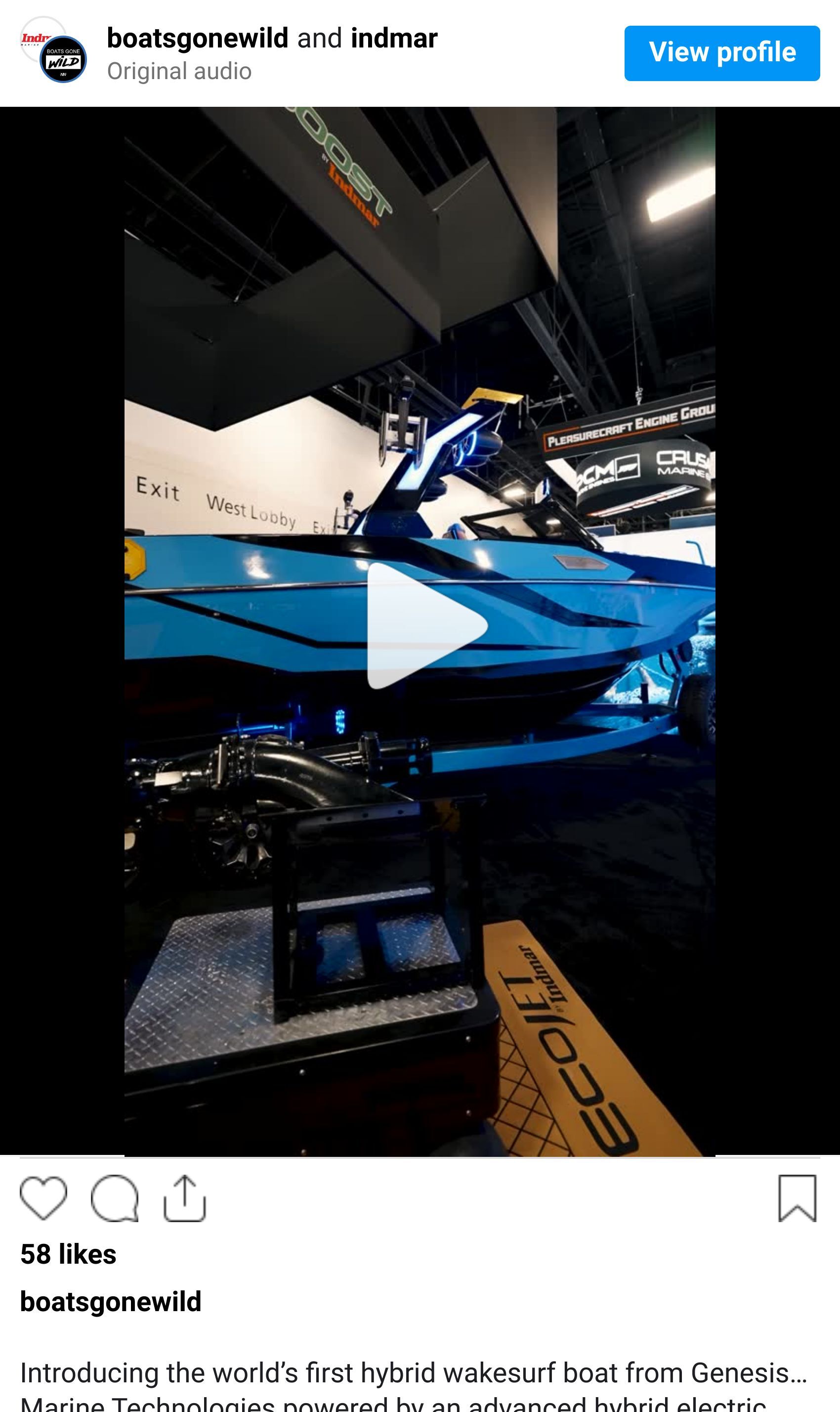
⚓️ Social Media Post of the Week
MIBS clip!
Dictate prompts and tag files automatically

Stop typing reproductions and start vibing code. Wispr Flow captures your spoken debugging flow and turns it into structured bug reports, acceptance tests, and PR descriptions. Say a file name or variable out loud and Flow preserves it exactly, tags the correct file, and keeps inline code readable. Use voice to create Cursor and Warp prompts, call out a variable like user_id, and get copy you can paste straight into an issue or PR. The result is faster triage and fewer context gaps between engineers and QA. Learn how developers use voice-first workflows in our Vibe Coding article at wisprflow.ai. Try Wispr Flow for engineers.
If you are finding this newsletter interesting or valuable, please help us by sharing this on social media and/or forwarding the registration link to a friend or colleague.
