Issue 126. Not a subscriber? Join here for free.
🌊 Neufoil Line-up
Nuefoil is building its lineup around an inflatable eFoil platform intended for riders who value stability, storage, and a short setup routine. The system is presented as a complete package with a stable board volume, a single shared battery spec across the range, and a product roadmap that includes a jet-drive option with an upgrade path for existing boards.
The main board offering is the Orca complete eFoil package. Published dimensions show a board length listed as 73.7 inches on the product page, while the pre-order deposit page lists 74 inches, with a consistent width of 31 inches and a volume of 135 liters. The deposit page lists total weight at 72 lb including battery and motor, and the FAQ also references an approximate board weight figure around 75 lb.
On-water performance claims are conservative in the published material. The deposit listing states a top speed of 30 km/h, and the FAQ presents a top speed range of 30–35 km/h. Nuefoil’s foil spec points toward lift and control: the front wing is listed at 1600 cm² area with an 88 cm span. This wing size signals a setup designed to make takeoff easier at lower speeds and maintain a stable ride for riders building confidence with pitch control and foot placement.
Nuefoil lists a battery at 43.2 V nominal, 33.6 Ah capacity, and 1451.52 Wh energy. The FAQ states a standard charge time of 2–2.5 hours, and a stated ride time of 40–80 minutes, depending on rider weight, speed, and conditions. This framing lets you describe real session planning without guessing: one charge supports a typical lesson-and-practice window, while a second battery supports back-to-back sessions without waiting on charging.
Drive configuration is a key part of Nuefoil’s positioning. Nuefoil distinguishes between a jet drive, described as an enclosed impeller system aimed at beginner safety, and a shrouded propeller setup, described as a traditional prop inside a guard with emphasis on efficient power and longer ride times. Their content describes the jet drive as in final development stages and designed to be compatible with existing boards for upgrades. For readers tracking product trends, this highlights a direction many eFoil brands are pursuing: moving from guarded props toward enclosed systems that reduce contact risk and shift maintenance patterns.
Nuefoil also sells supporting products that align with ownership realities: spare energy, transport, storage, and safety gear. The Extra Battery repeats the same published spec set of 43.2 V nominal, 33.6 Ah, and 1451.52 Wh, which makes it a clean add-on for riders who want longer days on the water or who share one board among multiple riders. The eFoil Storage Bag is described as a durable bag designed for transport and off-season storage, intended to work with the foam that ships with the board. This matters for inflatable-board buyers because long-term value depends on packing, storage, and protection being straightforward.
Nuefoil’s catalog also includes an “After Glow” complete board listing that repeats the same core platform dimensions and volume, and lists a bundled package that includes battery, motor, charger, remote, Bluetooth charging pad, pump, fasteners with hex key, and a magnetic switch. The listing status shows it as unavailable, but the content helps validate consistency of what Nuefoil considers “complete” for new buyers: board system, controls, charging, and assembly basics.
Vist their website for more: https://nuefoil.com
⚙️ eBoat Directory Links of the Week
Vessev VS-9 - A revolutionary 10-passenger electric hydrofoil ferry from New Zealand that "flies" above the waves to deliver a silent, smooth, and ultra-efficient commercial ride. (More details below, too) Link
Candela C-8 - The world's best-selling electric day cruiser, utilizing computer-stabilized hydrofoils to provide record-breaking range and a smooth flight over choppy waters. Link
Navier 30 - America's first all-electric hydrofoil boat, combining aerospace-grade technology with luxury design to offer a 75-mile range and advanced autonomous features. Link
RaceBird - The specialized electric foiling raceboat of the E1 Series, capable of reaching speeds up to 50 knots while banking through tight turns with incredible agility. Link
⚓️ Vessev VS-9
Vessev’s VS–9 sits in the part of the electric-marine market where the hardest problem is not propulsion, but resistance. At planing speeds, a conventional hull spends energy making spray, pushing a bow wave, and dragging wetted surface. The VS–9 tackles that problem with hydrofoils and a control system that lifts the hull out of the water once it reaches foiling speed. Vessev states the hull will lift at 17 knots, then adjust pitch, roll, and ride height in real time to stay stable, with manual height adjustment available.
The published technical profile reads like a commercial platform built for repeat duty. The VS–9 is 8.95 m long with a 3.1 m beam. Draft is listed as adjustable from 0.5 m to 1.5 m, which reflects the difference between foils retracted and deployed. Mass is listed at 3,300 kg with payload up to 1,000 kg. Hull construction is carbon fibre composite, a materials choice that aligns with stiffness, corrosion resistance, and weight control in a foiling craft where the structure supports both hull loads and foil loads.
Speed numbers are presented with clarity. Cruise speed is listed at 25 knots and top speed at 30 knots. Range is framed around cruise, with 40 nautical miles at full load and 50 nautical miles at light load. That spread is useful because it signals the operating envelope: Vessev is defining the boat around a repeatable cruise case rather than a low-speed displacement endurance claim. In practice, this is the pattern that will matter most for foiling water taxis, tourism runs, and waterfront shuttle routes where schedule, comfort, and predictable energy use drive adoption.
Seakeeping is defined around foiling limits rather than survival limits. Vessev lists foiling capability up to 0.75 m waves. That number is a reminder that hydrofoils are not a universal replacement for deep-vee planing hulls in open-ocean chop, but they can transform the ride profile inside bays, harbours, and coastal corridors where wave heights sit within a manageable band. It is also a reminder that route design becomes part of the product: with foiling craft, operators can gain efficiency and comfort by choosing paths that stay inside the sea-state envelope.
Energy storage is specified at 105 kWh battery capacity. Charging capability is listed as up to 22 kW on AC and up to 150 kW on DC. Vessev also describes charging in operational terms, publishing a “charge rate” metric and a separate FAQ statement on maximum battery charge rate. In the technical specs, the VS–9 is listed with charge rate up to 1.25 nautical miles per minute. In the FAQ, Vessev states the battery’s maximum charge rate is 90 kW and frames DC charging as delivering 0.8 nautical miles of foiling range per minute of charging. Read together, the message is that the boat is designed to fit both slower shore power and faster commercial-style DC charging, with range recovery expressed in route planning units rather than percent bars.
The propulsion and control stack is positioned as a system rather than a collection of parts. Vessev highlights a submerged propulsion system with active cooling intended to support operation in warm climates, paired with a flight-control computer and sensor suite that manages stability during foiling. The foils are described as fully retractable, which matters for docking, beaching constraints, and maintenance access. Vessev also describes how the boat approaches debris risk: foils made from solid carbon fibre are designed to break away under severe shock to protect the hull, with replaceable components intended to return a vessel to service without a long yard cycle.
Commercial readiness shows up in certification and support posture. Vessev states the VS–9 has been designed to DNV standards and certified by Maritime New Zealand, with additional international certifications in progress. The company also describes remote monitoring through detailed telemetry data, enabling real-time performance visibility and remote support. That matters for early fleets because uptime is the product: the operator buying a foiling electric vessel is buying schedule reliability, service simplicity, and the ability to diagnose issues without a specialist flying in.
The VS–9 is best understood as a route machine. Its published numbers point to harbour-speed service with a defined cruise band, a defined sea-state band, and a battery and charging profile aimed at turnarounds between trips. For electric boating, that is where hydrofoils earn their place: when you reduce drag at speed, the same stored energy buys a longer route, a higher cruise speed, or a tighter timetable. The result is not just an electric boat that goes fast; it is an electric boat that can make a business case in the waterborne mobility lanes where internal combustion has held the advantage for decades.
Vessev website: https://www.vessev.com/vessels/vs-9
🖌️ Social Media Post of the Week
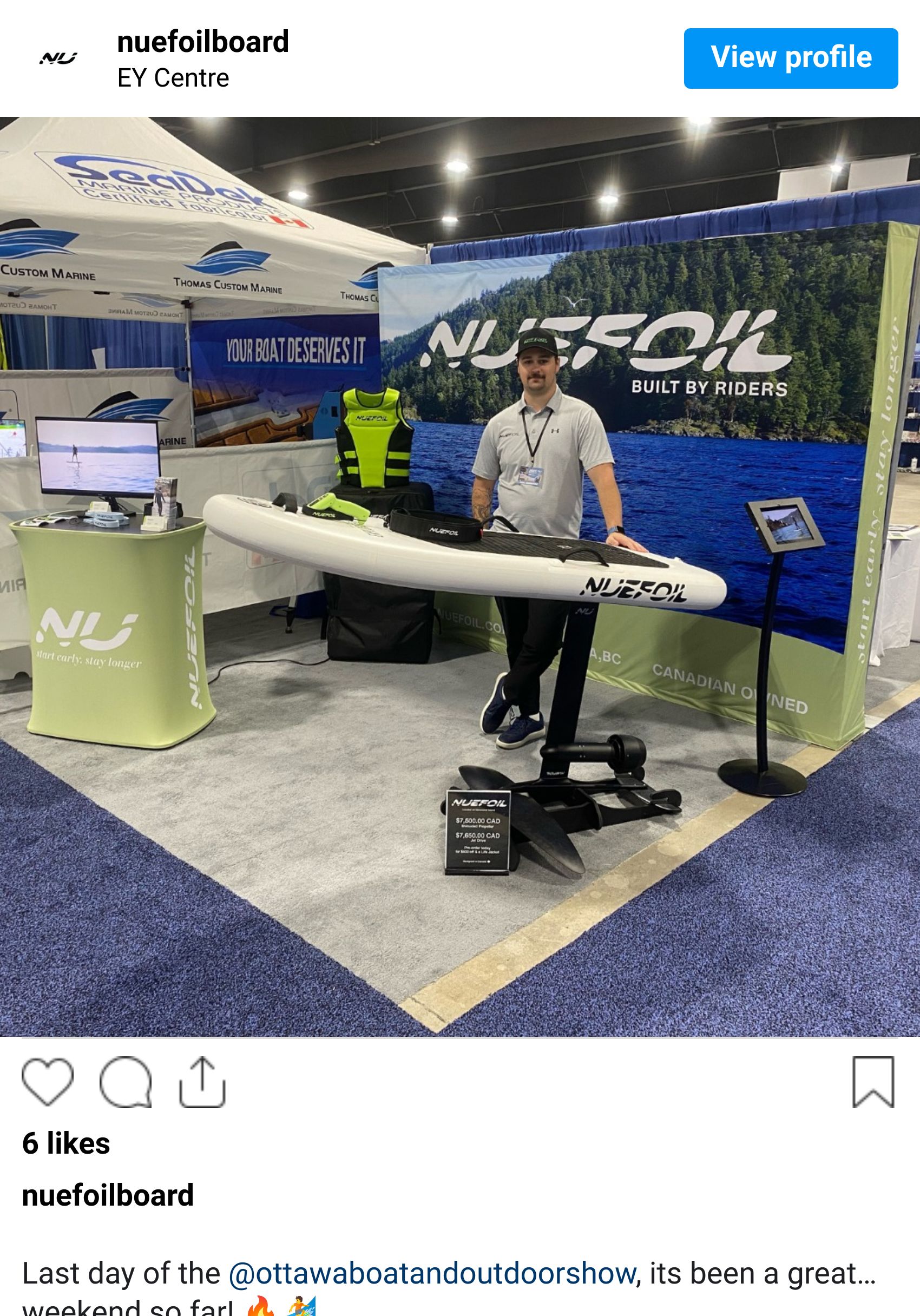
Neufoil exhibited at the Ottawa Boat and Outdoor show. Snow banks everywhere outside, but thoughts of summer inside.
🖌️ 75HP+ Outboard Engines
Electric propulsion has moved beyond trolling motors and displacement cruisers. Multiple manufacturers now offer electric outboard systems that match the real-world thrust and duty cycle of 75 hp and above. That power class can push planing hulls, not just slow cruisers. It opens electric propulsion to runabouts, pontoons, RIBs, and light commercial craft.
This shift matters because 75 hp marks the entry point for mainstream recreational boating. Below that range, electric has served as auxiliary power and short-range propulsion. Above it, electric becomes a viable replacement for the gas outboards that dominate family boating and small workboat fleets.
How to read “hp-equivalent” claims
Gas outboards are rated by peak horsepower at wide-open throttle. Electric systems often publish continuous power plus a higher peak rating for short bursts. Continuous prop shaft power is the anchor metric. Torque and prop selection shape on-water results.
A rough conversion helps set expectations: 1 hp equals 0.746 kW. A “75 hp-class” electric outboard usually needs on the order of 55 kW continuous output, with a higher peak for acceleration. When manufacturers market “hp-equivalent,” they often refer to thrust and acceleration, not a direct peak-to-peak horsepower match.
Mercury Avator: A legacy brand commits to electric
Mercury’s Avator line is signaling a massive commitment from the world's top outboard manufacturer. While the initial models focused on portable power, the expansion into higher output classes is well underway.
The Mercury Avator 110e delivers about 11 kW of continuous power. While positioned as comparable in thrust to 15 hp gas outboards, the platform's modular 48V LFP battery system and SmartCraft integration set the stage for much larger systems. The key point is market validation: dealer networks, service standards, and consumer confidence follow the incumbents.
Torqeedo Deep Blue 50R: The early benchmark for high power
Torqeedo helped define the high-power electric outboard segment with the Deep Blue series. The Torpedo Deep Blue 50R delivers about 50 kW continuous at the prop, which places it in the 80 hp class by continuous output. It uses a high-voltage architecture and pairs with large battery packs in the 38–77 kWh range.
This system has seen deployment in commercial and heavy-duty recreational use. It proved that electric outboards can handle sustained load, not just short demonstrations. Weight and price remain barriers, but the Deep Blue set a reference point for the segment.
Vision Marine E-Motion 180E: Electric outboards enter the runabout core
Vision Marine’s E-Motion 180E targets the heart of the recreational market: 18–25 ft planing boats. The system is marketed as 180 hp equivalent. Its continuous power rating sits lower than that headline figure, but on-water performance has matched the intent: strong acceleration, fast planing, and top-end speed suitable for common bowriders and sport pontoons.
The 180E package includes the outboard, a large battery pack around 60 kWh, controls, and a display. It uses a high-voltage architecture and liquid cooling. Vision also pushed visibility through high-speed demonstrations, including a twin-motor record run. The takeaway is that electric outboards can power performance hulls, not just quiet cruisers.
Evoy: Electric propulsion as a system, not an engine
Evoy focuses on integrated propulsion stacks for fast boats. Its Evoy Breeze 120+ class system delivers about 90 kW continuous output, with peak power available for acceleration. Battery capacity varies by configuration, often in the 50–75 kWh range.
Evoy ships with a dedicated helm display, software updates, remote diagnostics, and connected features. Charging options include higher-power AC hardware, and the company has discussed DC fast-charge compatibility. Evoy also outlines a roadmap for larger systems in the 300 hp class and beyond, aimed at tougher applications and higher speed boats.
ACEL Power: The 75 hp threshold product
ACEL Power’s IE series targets the 75 hp range as a critical threshold. The IE 75 is positioned as a true 75 hp continuous outboard, offered as a full system with batteries, digital controls, display integration, and connectivity.
ACEL has also presented plans for higher-power models like the IE 150 and the flagship IE 250. This matters because 75 hp is the category that maps to common family boats and fishing rigs. A dependable 75 hp electric outboard with strong support can unlock a large installed base of hulls that boat builders and repower customers already understand.
What changes when boats can plane on electric
Planing hulls demand high power. At speed, energy draw rises fast. A 50–60 kWh pack can drain quickly at wide-open throttle. That limits full-speed range. It does not eliminate the use-case for many boaters.
Many recreational days include bursts of power plus long idle periods: towing, cruising between coves, fishing at low speed, swimming, and dockside time. Fleets and tour operators also return to base often, which fits charging routines. For these patterns, electric outboards can deliver the experience people care about: torque, smooth control, low noise, no fumes, and reduced maintenance.
Battery weight changes design. Packs need placement low and central. That can improve stability and ride, but it requires hull planning. Commercial operators can also justify higher upfront cost with lower energy and maintenance spend over time.
What to watch next
Three factors will shape the next phase of the electric transition:
Charging: Dockside infrastructure and higher-power charging options.
Power Density: Lighter motors and better system integration.
Cost: Scale, competition, and maturing supply chains.
The 75+ hp class is the adoption hinge. It is where electric outboards move from niche propulsion to practical replacement. The boats people already own and the boats builders already sell can go electric without a new category of boating. That change is underway.
If you are finding this newsletter interesting or valuable, please help us by sharing this on social media and/or forwarding the registration link to a friend or colleague.
