In this issue: Electric hydrofoils, autonomous boats, and a modular watercraft that does five jobs with one drive unit. This issue covers the full spectrum — from a Queen's University student team placing on the world stage to a Hong Kong innovator rethinking how electric ferries get charged.
⚡ E-HAWC: Gerhard Kutt Launches an All-Electric Hydrofoil Water Taxi Platform Concept
Gerhard Kutt, the Hong Kong-based marine innovator and competitive water ski background specialist behind HAWC Technologies, has announced E-HAWC — a fully electric, hydrofoil-assisted platform designed for commercial water taxi and sea truck operations.
The E-HAWC 11M is built on proven HYSUCAT (Hydrofoil-Supported Catamaran) and HYSUWAC foil technology developed by Professor KG Hoppe, and carries DNV and CCS type approval. The foil system is DNV-classified, providing the kind of stability and efficiency validation that commercial operators and insurers require. The vessel delivers a cruising speed of 30 knots and is configured for 12 to 18 passengers across water taxi and sea truck variants. Battery capacity runs between 400 and 600 kWh using Gotion LFP (lithium iron phosphate) cells, a chemistry chosen for its thermal stability and cycle life in demanding commercial duty.
What distinguishes the E-HAWC platform from a conventional electric vessel program is the inclusion of a purpose-built charging infrastructure solution. Kutt has developed a BESS (Battery Energy Storage System) Super Charging solution delivered via mobile or marina-based Charge Barges. These platforms are designed to enable high-speed charging independent of local grid capacity — a direct response to one of the most persistent barriers to electric ferry and water taxi deployment in island, coastal, and inland waterway markets. Solar integration is available for off-grid configurations.
Kutt is currently seeking inaugural clients and strategic partners including ferry operators, marina owners, island transport providers, and commercial users. He has indicated that detailed technical specifications and operational data are available on request.
Read more, here.
⚓ E1 Heads to Dubrovnik: Championship on the Line
The UIM E1 World Championship returns to the Adriatic this weekend as ten teams converge on Dubrovnik, Croatia for Round 3 of the 2026 season. Racing takes place June 12 and 13, with the RaceBirds competing along one of the Adriatic's most iconic coastlines.
The championship picture is tight. Angola Westbrook Racing, piloted by Sara Price and Lucas Ordóñez and owned by Will Smith, leads the standings on 60 points, with Team Brady three points back at 57 and Aoki Racing Team close behind at 55. Westbrook claimed that lead with a hard-fought win at Lake Como in late April, recovering from early race damage to take both Finals.
Dubrovnik became a firm favourite with fans after E1's first appearance there last season, with large crowds lining the shoreline to watch the RaceBirds contend with the challenging open-water conditions of the Adriatic Sea.
The boats themselves remain a compelling part of the story. The RaceBird is a 7.5-metre all-electric hydrofoil, constructed from carbon fibre, powered by a 150 kW electric motor drawing from a 35 kWh battery pack. It foils clear of the water at 17 knots and reaches a top speed of 50 knots (93 km/h). The cockpit seats a single pilot behind a steering wheel and pedals, configured much like a single-seater race car. The drivetrain pairs a custom Mercury Racing electric outboard with a lithium-ion battery system from Kreisel Electric.
Each team fields one male and one female pilot, competing across qualifying, group stage races, and two Finals. Points run from 38 for the winner down to 3 for tenth place, with bonus points available for top qualifiers and fastest lap.
The race begins at 10:00 a.m. ET on Saturday, June 13. E1 streams all sessions live on its official YouTube channel. US viewers can also watch through Fubo TV. No cable subscription or geo-restriction applies to the YouTube stream, making it the simplest option for Canadian viewers.
Read more, here.
🚢 Queen's University Is Building the Future of Autonomous Electric Boats
A student engineering team out of Kingston, Ontario is making a serious mark in international autonomous marine technology. aQuatonomous, based at the Stephen J.R. Smith Faculty of Engineering and Applied Science at Queen's University, placed 3rd in the RoboBoat 2026 final standings competition in Sarasota, Florida — competing against 37 teams from 10 countries.
The team's vessel for the 2025–2026 season is the Frontenac, named for the county and lake that surround Kingston. It is a catamaran-hulled autonomous surface vessel (ASV) built for reliability and modular field deployment. The wide catamaran beam reduces roll and provides a stable platform for onboard sensors and autonomy systems. The hull, bridge, and electrical systems are designed to detach from one another for transport.
The Frontenac's technical stack reflects the current state of the art in small-vessel autonomy. Navigation is handled by a Pixhawk 4 flight controller paired with an M10 GPS module and a 6-axis IMU running an Extended Kalman Filter for localisation, with a secondary 9-axis IMU aboard the compute unit for redundancy. Perception relies on a Unitree 4D LiDAR L1 mounted forward for collision detection and three Arducam AR0234 wide-coverage cameras. The compute core is an NVIDIA Jetson Orin Nano running ROS 2 Humble, communicating with the Pixhawk via MAVLink and MAVROS.
The team competes on two fronts: the RoboNation RoboBoat competition, which tasks ASVs with fully autonomous navigation, obstacle avoidance, docking, and payload delivery challenges, and the Toronto Solar Boat Race, where the solar-powered propulsion system takes centre stage. Beyond competition, aQuatonomous offers its vessel to water and environmental researchers as an instrumented field platform.

Source - aQuatonomous website
The team was founded in 2023 and has grown to more than 40 active members drawn from mechanical, electrical, perception, software, and ecological sub-teams. To support knowledge transfer, it runs NAVIS (Nautical Autonomy, Vessels and Innovation School), an internal training program that introduces junior members to ROS 2, robotics algorithms, sensor integration, control systems, and naval architecture through a small-scale ASV build program.
The Frontenac's podium finish at RoboBoat 2026 represents a significant jump for a team that launched its first prototype on Lake Ontario only three years ago.
Read more, here.
🌊 Events
Lake Berryessa Electric Boat Festival 2026
Billed as the World's Largest Electric Boat Experience, this hands-on public festival at Pleasure Cove Marina in Napa, CA, lets attendees ride, drive, and test out the latest electric speedboats, personal watercraft, and electric outboards in a festive waterfront atmosphere.linkMonaco Energy Boat Challenge 2026
A premier international showcase and "living laboratory" hosted by the Yacht Club de Monaco. It gathers university teams and industry pioneers from over 20 countries to race and test prototype vessels powered by solar, hydrogen, electricity, and autonomous AI guidance. linkE1 Luanda GP 2026
Round 5 of the UIM E1 World Championship. Watch the revolutionary all-electric hydrofoil "RaceBirds" compete at high speeds in Luanda Bay, Angola, marking the championship's first race in Southern Africa. linkINTERBOOT Friedrichshafen 2026
One of Europe's largest annual watersports exhibitions, held in Friedrichshafen, Germany. The event has a massive focus on next-generation electric propulsion, hybrid motorboats, and electric sailboats, including on-water demonstration rides on Lake Constance. linkE1 Lagos GP 2026
Round 6 of the UIM E1 World Championship. The zero-emission electric hydrofoils return to Lagos Harbor, Nigeria, combining elite-tier racing, high-profile celebrity owners, and sustainable coastal engineering. link
🌊 Mo-Jet: One Drive, Five Watercraft
German engineering company Jetworx GmbH has built a modular electric watercraft system that turns a single propulsion unit into five distinct vessels. The product, called mo-jet, started as a Hamburg investment banker's hobby project in 2009 and went through two company formations, an insolvency, and fifteen years of engineering iteration before reaching its current production form.
The system's architecture separates propulsion from shape. A single rear drive module — built from polyethylene, torsion-resistant, and shock-proof — houses two removable lithium-ion battery packs and an electric waterjet unit. That drive module connects to five interchangeable front bow modules: a Surf jetboard, a Body prone bodyboard, an Air inflatable board for heavier riders or beginners, a Wake board for tow-behind use, and a 2.38-metre inflatable Tender boat. Modules attach via two screws using an included hex key. The entire system is designed to be carried, stored, and transported without a trailer or davit.
The drive unit's core specifications: 100 kg of standing thrust, a top speed of 55 km/h (34 mph), dimensions of 90 × 65 × 21 cm, and a total weight of 39.3 kg including batteries. Battery runtime runs up to 40 minutes depending on load and configuration. The dual-battery system charges in 45 minutes via two standard household sockets — a specification Jetworx identified early as critical for the rental market, where a single unit can turn over multiple sessions in a day.
The propulsion system uses a waterjet rather than an exposed propeller, eliminating the rotating blade hazard relevant in swim zones and charter environments. A wireless handheld remote controls speed. An emergency stop lanyard is included as standard.
The Tender configuration deserves particular attention for eBoat readers. Connecting the drive module to the inflatable 2.38-metre hull produces a compact electric tender capable of ferrying crew and gear to and from anchored vessels — a practical application that emerged almost by accident when co-founder Benjamin Köhnsen attached a prototype adapter to an inflatable in 2023 and found the handling characteristics compelling enough to productise.
Jetworx GmbH was founded on 19 December 2019 by Carsten Höltig, Holger Daum, Jennifer Köhnsen, and a group of investors, several of whom had backed the earlier Sashay GmbH / Lampuga jetboard venture. MBG Schleswig-Holstein, a German public financing institution, participated in both companies — an unusual degree of institutional continuity across a prior insolvency. The company also carries a broader patent portfolio protecting the modular architecture.
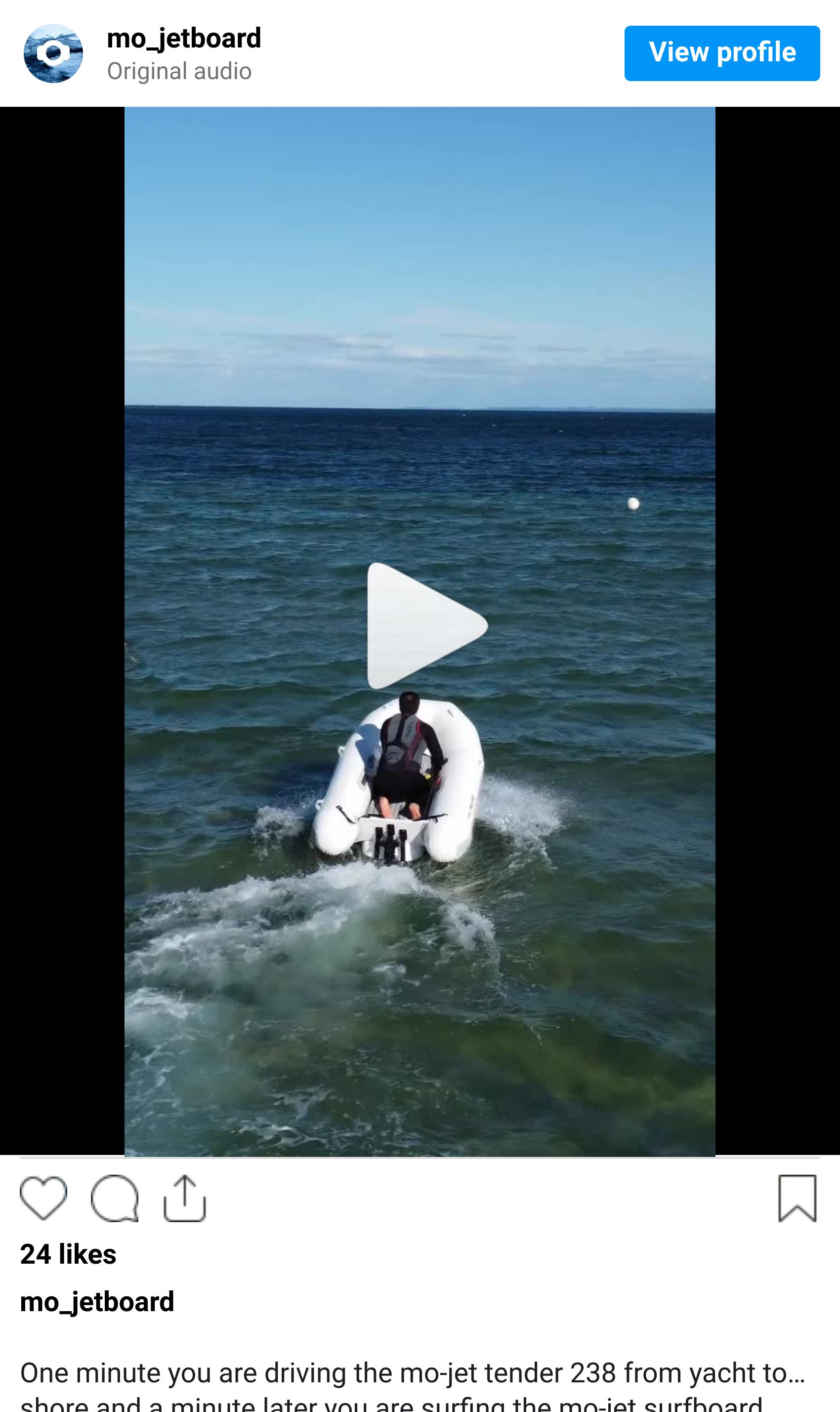
Mo-jet is now in active deployment at rental operations including La Reserva in Sotogrande, Spain, and appeared at the Dalmatia Boat Show, Palma International Boat Show, Superyacht Show Türkiye, and Salone Nautico Venezia in 2026.
Read more, here.
🖌️ Social Media Post of the Week
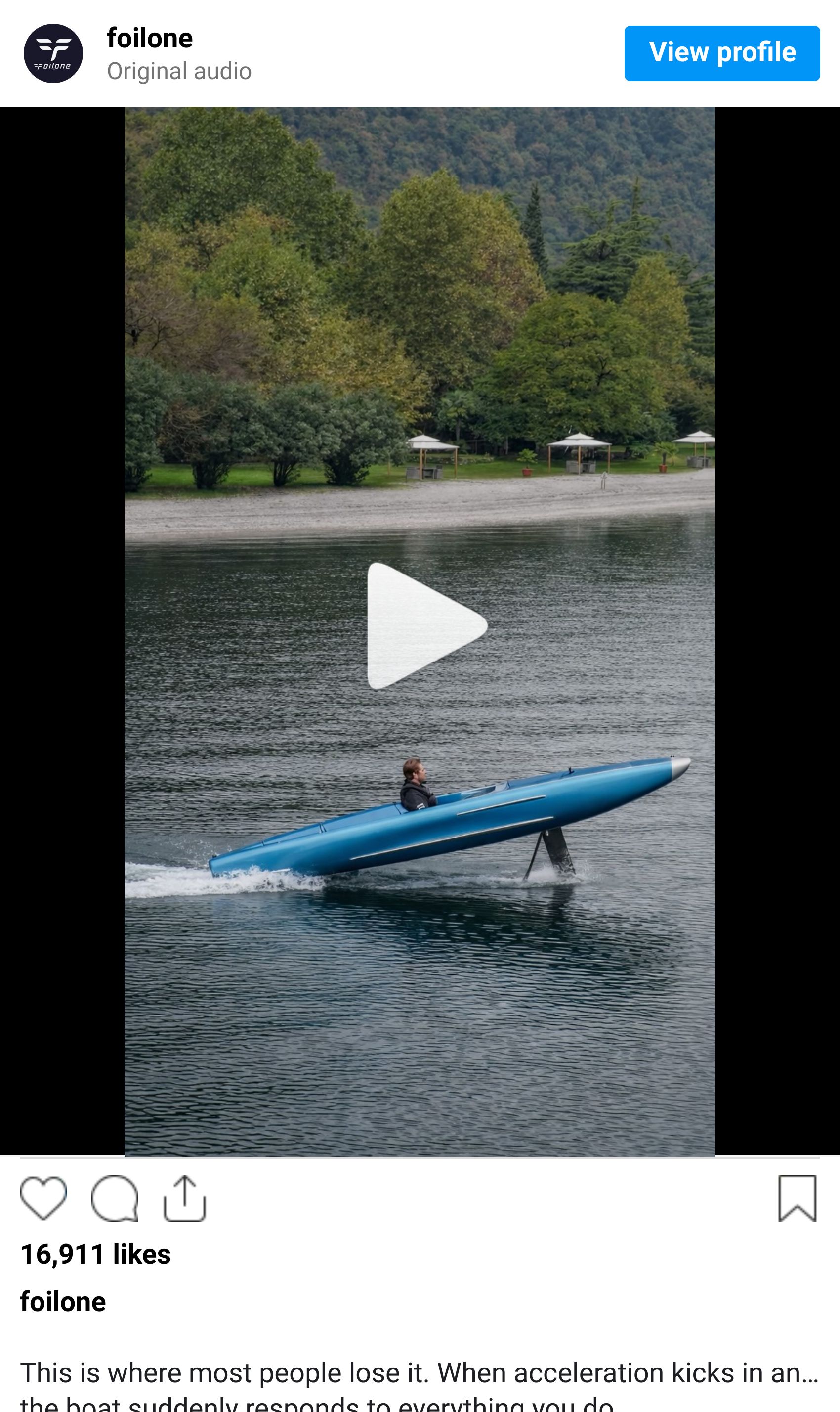
Foilone running demos this summer in Europe!
If you are finding this newsletter interesting or valuable, please help us by sharing this on social media and/or forwarding the registration link to a friend or colleague.
